|
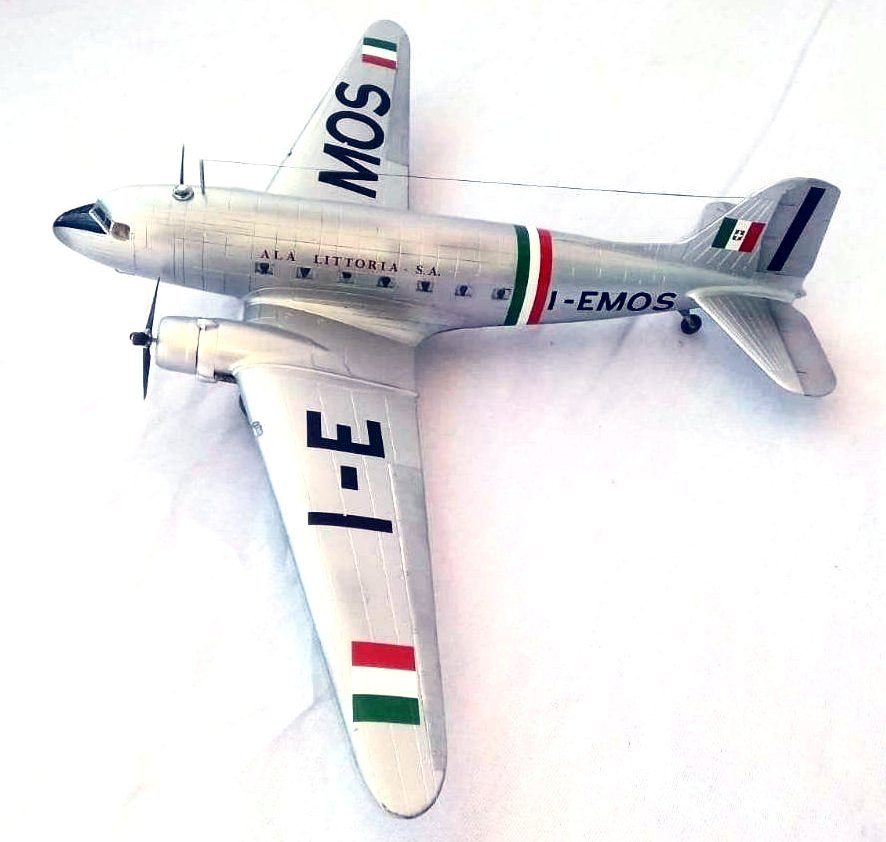
Italeri 1/72 Douglas DC-3 Civil Transport by Vince Fiore |
|

Click the STORMO! Eagle to return to the Gallery |
|
The Douglas DCs served for many decades and some are still in use today. A total of about eleven thousand aircraft were built in military and civil versions. The DCs are the most important family of transport planes in the history of aviation. The DC was born as a direct competitor of the Boeing 247. With the Boeing aircraft, United Air Lines dominated American commercial aviation. TWA set out to find a competitive aircraft, and so was born the DC family. The DC-1 was immediately followed by an improved version, the DC-2. Then it was American Airways' turn. Neither the Boeing 247 nor the Douglas DC-2 was available to that company, and a third Douglas, the final version, the DC-3 was produced. This was the best known and most popular of the DCs. Not only were the planes a commercial success but they earned Douglas Aircraft great prestige in transport aircraft construction. And ever since the 1930s the initials DC (Douglas Commercial) have been applied to a long line of distinguished aircraft. What TWA originally asked for was a three-engine, all-metal plane with cruising speed of about 150 mph (240 km/h), a range of about 1,000 miles (1,600 km), and a ceiling of 20,000 feet (6,000 m); a plane that could carry at least twelve passengers with maximum comfort. TWA approached all the leading American aircraft manufacturers, but the Douglas Aircraft Company was the first to respond. Five days after receiving TWA's letter, Douglas was in touch with the airline. And after three weeks of meetings, when a twin-engine plane was decided on, the contract was signed. The date was September 20, 1932. TWA ordered a prototype DC-1 with an option for sixty aircraft. Ten months later, on July 1, 1933, the plane was in the air. It was an elegant, low-wing monoplane with the main features of its direct rival and several new features as well. The new plane delivered more than TWA had asked for. The DC-1 could accommodate twelve passengers in a much more spacious and comfortable cabin than the 247s. The aircraft was delivered to TWA in September, and the company immediately ordered forty of the improved model, the DC-2 (The DC-2 was already in an advanced stage of construction). The DC-2 first took to the air on May 11, 1934, and one week later it was flying the TWA Columbus-Pittsburgh-Newark run and outdoing the 247 for speed. On August 1, the DC-2 was put on the longest (18 hours) and most important run, New York to Los Angeles. There was nothing United could do to match the overwhelming superiority of TWA's DC-2s. United and all the other airlines had to wait for Douglas to complete TWA's order. Now TWA led the market. The Douglas DC-2 was successful in Europe as well. The first European company to buy the DC-2 was the Dutch airline KLM. After winning London-Melbourne race in October 1934, the Dutch company ordered a total of fourteen DC-2s. Other airlines in Europe followed KLM's lead. Douglas built a total of about 200 DC-2s before closing down the production line in 1936, when the DC-3 made its appearance. The DC-3 was developed for American Airways, which was looking for a plane to replace its Curtiss Condors on night flights. The DC-3, a larger and more powerful variation of the DC-2, made its first flight on the New York-Chicago non-stop run in June 1936. The DC-3 was an enormous success. In the end there were DC-3s with every airline in America and in most of the leading European airlines as well. Before the United States entered World War II, a total of over 800 aircraft had been built and sold. More than ten times that number were built during the war. The inimitable qualities of the DC-3 made it the most versatile and practical aircraft in the history of military transport. Source: Angelucci, E. and P. Matricardi, World Aircraft 1918-1935, Sampson Low Guides, Berkshire, 1977 |


|
|
|

|
|
|

|
|
|

|
|
|
This is a DC-3 in pre-war-service with Ala Littoria. The base kit is the 1/72 Italeri C-47, converted to a DC-3. It is a simple conversion. All that was necessary was to eliminate the cargo door. I glued the cargo door into its position. Next I sanded off the hinges. With this done I filled-in the area where the door is connected to the fuselage. I then sanded this area smoothly. It was now necessary to scribe the panel lines to this area. With this done I gave the site a coat of primer to check that everything was to my satisfaction. I then gave the interior a coat of paint. After the paint dried I glued the windows in place. Next I added window curtains, these I bought from Arctic decals. Next, build the rest of the interior. With this done I installed the carpet glazing. This was the only place I had a problem with the build. The glazing on the left side protruded out. I placed tape around the work area and sanded the clear part until it was flush with the airframe. Using sanding sticks I sanded and a number of different grades of sandpaper I restored it to the proper clear appearance. With all this done I proceeded to build the rest of the kit. When completed I gave it a coat of primer to check for defects. Defects were corrected. A Gloss black was then sprayed over the entire airframe. I painted the rudder and ailerons with Testors silver as these were fabric covered. The rest of the model was painted with Mister paint white aluminum. With a very soft wide brush, I applied a coat of pledge. Next I applied decals. These were Tauromodael art 72-558, which I obtained from Mister Kit of Italy. The only thing I would do differently is I would not use the band around the fuselage because it was too thick and did not settle down into the panel lines well - I'm assuming this was because it required three different paints creating a thicker decal. I then added the landing gear, props, antenna mast and aerial line. A pleasant easy build for a change.
|
Aircraft: Douglas DC-3 Manufacturer: Douglas Aircraft Co. Type: Civil Transport Year: 1936 Engine: Two Pratt and Whitney, 9-cylinder radial, air-cooled, 1,200 hp each Wingspan: 95 ft (28.96 m) Length: 64 ft 6 in (19.65 m) Height: 16 ft 11 in (5.15m) Weight: 25,200 lb (11,400 kg) Maximum Speed: 180 mph (290 km/h) Ceiling: 23,200 ft (7,070 m) Range: 1,300 miles (2,100 km) Crew: 2 Passengers: 14-32 |
|


|


|

|
|
|
|
|
|
|
|
|
|
|
|
February, 2023 STORMO! © 2023 |