|
Planet Models 1/72 FIAT CANSA FC.20bis Ground Attack by Richard Mendes |

|

Click the STORMO! Eagle to return to the Gallery |
|
The Construzioni Aeronautiche Novaresi S.A. (CANSA, a FIAT subsidiary from July 1, 1937 onwards) FC.20 was a mixed wood, metal and fabric constructed twin-engine aerial observation reconnaissance, dive bombing and ground attack monoplane originally designed in response to a 1937 Regia Aeronautica Italia (RAI) specification for a high performance twin-engine aerial observation reconnaissance aircraft in part to replace the aging Industrie Meccaniche e Aeronautiche Meridionali (IMAM) Ro.37 observation reconnaissance biplane. Designed by CANSA’s Giacomo Mosso (1903-1988) incorporating FIAT’s Celestino Rosatelli’s (1885-1945) development work in designing the CR.25 twin-engine multi-role aircraft incorporating its wings, engines and landing gear, the FC.20 powered by FIAT A.74 14-cylinder radial engines competed against the Aeronautica Umbra S.A. AUT.45 designed by Felice Trojani (1897-1971), Societa Aeronautica Italiana Ambrosini SA.9, Caproni-Bergamasche Ca.331 designed by Cesare Pallavicino (1893-1976) and IMAM Ro.61, the RAI authorizing construction of two prototypes each of the AUT.45 (subsequently cancelled), Ca.331 and FC.20 in 1938 for flight testing the FC.20s being assigned serials MM.403 and MM.404. Whilst FC.20 development was ongoing the RAI began favoring the more aerodynamically refined metal monocoque Ca.331 the first prototype MM.427 flying on August 31, 1940, demonstrating flying characteristics more in keeping with its intended aerial observation reconnaissance role the RAI had second thoughts regarding further FC.20 development nevertheless allowing the first prototype MM.403 to fly at the CANSA factory in Cameri, Italy on April 12, 1941 armed with a dorsal turreted 12.7mm machine gun (a 7.7mm ventral one was considered but not installed) long after the type had been rejected (see below). Whilst flight testing of both aircraft types was occurring at Guidonia Monticello the RAI turned eyes on the Caproni Ca.313, first flown on December 22, 1939 with Isotta Fraschini Delta 12-cylinder inverted V engines it was faster than its parent the Piaggio Stella P.VI I 7-cylinder radial-powered Ca.311 but just as vulnerable to air attack, structural failures whilst employed as a dive bomber, Delta engines failing due to cylinder overheating nevertheless adopting it for general aerial observation reconnaissance duties in lieu of the Ca.331 and FC.20. Rejected for aerial observation reconnaissance the FC.20 gained favor from RAI Capo di Stato Maggiore Rino Corso Fougier (1894-1963) in late 1940 issuing Request for Proposals for a twin-engine ground assault and/or dive bombing attack aircraft. CANSA quickly adopted MM.403 officially designated as the FC.20ter Dive Bomber still powered by FIAT A.74 radials with mainwing dive brakes, one fuselage mounted bomb rack carrying a 500kg bomb, 12.7 mm machine gun mounted in the inside port wing leading edge (not installed), removal of fuselage fuel tanks and modifications to the tailplane stabilizers, retractable landing tailwheel et. al.. The second prototype MM.404 also powered by FIAT A.74 radials was to be built as the FC.20bis Ground Attack plane:
• The entire forward fuselage
"greenhouse" replaced with a solid nose fitted with a Breda 37/54 37mm cannon with fuselage bottom shell case ejector; FC.20ter flight testing commenced on October 31, 1941 at Guidonia continuing into January 1942 with 500kg bombs, unimpressed with its performance the RAI lost interest further developing the type but nevertheless allowed installation of a long-barrel Breda Mod.39 37/54 37mm cannon mounted underneath the fuselage "greenhouse" for test evaluation. On April 1, 1942 the cannon-armed FC.20ter first flew, transferred to Guidonia on the 13th for flight testing in May it was returned to CANSA in Cameri for engine replacements and other modifications whilst there redesignated as the FC.20A (Artiglierie), flown back to Guidonia for Breda cannon firing tests heavy vibrations fractured glazed panels as well as causing airframe structural damage, flown back to Cameri on April 9, 1943 the RAI authorized the airframe to be rebuilt as an FC.20bis. Besides the FC.20, FC, 20bis, FC.20ter/FC.20A variants described above CANSA built the FC.20quater powered by 1050hp Alfa Romeo RA.1000 12-cylinder Inverted V inline engines, the fuselage nose mounted Breda 37/54 37mm cannon supplemented by four 20mm Mauser cannons, two replacing the mainwing root-mounted 12.7 machine guns, others mounted in the forward fuselage. Assigned FC.20bis serial MM.077570 retouched photographs of MM.404 standing in for the FC.20quarter have been in circulation since WWII though none yet in print. Other FC.20 airframe developments included:
• The FC.20 Radar Night Fighter – FC.20bis equipped with FUG 212 “Lichtenstein B/C radar; The FC.19 "Strategic Observation" twin-engine monoplane structurally similar to the Ca.311 powered by Isotta Fraschini Delta or 600hp FIAT A.30 12-cylinder liquid cooled inline engines purportedly was a Caproni design project FIAT inherited via CANSA, though not related to the FC.20 it possibly could had been developed in parallel with in response to the 1937 RAI high performance twin-engine aerial observation reconnaissance aircraft specification.
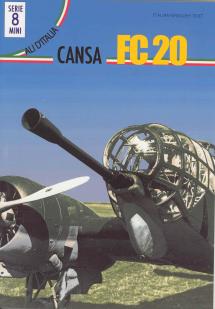
The operational histories of the nine FC.20 aircraft are detailed in Ali d'Italia Serie 8 Mini CANSA FC.20 by Luigi Gorena (2005) pages 9 to 13 notable highlights being:
• Three missions over Campania, Italy with MM.403 flown by Capitano Corrado Ricci of 167 Gruppo Intercettori attacking U.S.A.A.F. Consolidated B-24 Liberators c. spring-summer 1943; |

|

|

|
|
|
|
|
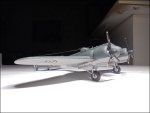
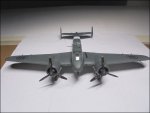
Resin 1/72 scale models of the CANSA FC.20A MM.403 and factory as-built FC.20bis MM.075570 marketed under the Czech Master Kit, Italian Wings, Legato, Planet Models et. al. labels have been in "limited" production since the early 2000s from a common set of molds, the original maker of which I've yet to identify. In 2009 I purchased the Planet Models issues to build after gaining enough experience building resin models in 2012 I successfully did so fortunately without serious problems. The kit castings are good though tad rough in places, mainwings and center section, engine cowlings for FIAT A.74 radial engines single castings greatly simplifying construction separate fuselage halves being provided for FC.20A FC.20bis versions. Fuselage interior detail is adequate though nice if etched brass detail parts had been included as well as accurate casts of the A.74 engines in lieu of the inaccurate laboriously built-up ones provided with the kits. The "clear" vacuform cockpit and "greenhouse" canopies and fuselage windows for the FC.20A as well as those for the FC.20bis were very thin as well as not clear, Herculean efforts necessary assembling and gluing in place the three-piece FC.20A "greenhouse", Breda cannon and shell hopper assemblies though alas no 37mm shell castings were provided. The warped cannon barrel casting posed a knotty dilemma: straighten-out risking breaking or leave alone, wisely chose the latter! The kits lacked aileron, tailplane elevator and rudder actuator parts so made them from scratch with sheet styrene plastic and nylon fishing line this years before switching to EZ Line stretch thread. Painting the Planet Model kits was straightforward all spray work being accomplished with Testors Aztek A320 Single and A470 Double Action airbrushes, 9304CX 0.30, 9305CX 0.40, 9306CX 0.50 mm spray nozzles. Interiors were painted Humbrol 78 Matt Cockpit Green and Testors Flat White 50/50 mix replicating Verde Anticorrosione, exteriors Humbrol 91 Matt Black Green replicating Verde Oliva Scuro 2, Testors Model Master 1726 Light Sea Gray replicating Grigio Azzurro Chiaro 1 each lightened 36% with Testors Flat White enamels along with a white identification band painted around the rear fuselage, Testors Aluminum, Black, Bronze, Olive Green, Red, Rubber, Rust et. al. flat enamels employed as detailing colors. Model kit decals provided include those for the FC.20A MM.403 and factory as-built FC.20bis MM.075570, as well a few problems were encountered applying them. Both aircraft were over-sprayed with Testors Model Master Semi-Gloss Clear Lacquer Finish thinned 50% with Klean Strip Lacquer Thinner (WAY cheaper than Model Master thinner and just as good), prefer semi-gloss finish over flat, detail "pops out" better plus aesthetically more pleasing in appearance. |
Aircraft: C.A.N.S.A. FC.20 Manufacturer: Construzioni Aeronautiche Novarcsi S.A. (FIAT) Type: Ground Attack Year: 1941 Engine: Two Fiat A.74 RC 38. 14-cylinder radial. air-cooled. 840 hp each Wingspan: 52 ft 6 in (16.00 m) Length: 39 ft 11 1/2 in (12.18 m) Height: 13ft 2 in (4.00 m) Weight: 13,950 lb (6,320 kg) (Loaded) Maximum Speed: 261 mph (420 km/h) at 14.700 ft (4,500 m) Ceiling: 24,110 ft (7,350 m) Range: 715 miles (1,150 km) Armament: 3 machine guns: 1 37 mm cannon Crew: 2-3
|
|
|




|
|
|
|
|


|


|
|
|
|
|
|
August, 2020 STORMO! © 2020 |