|
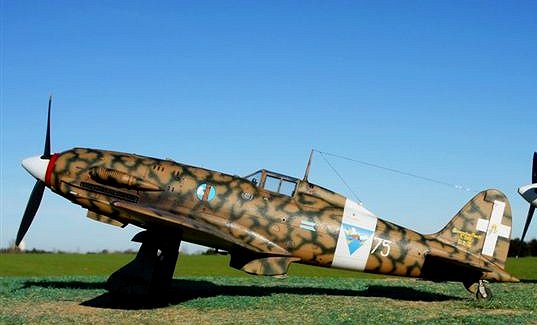
Hasegawa 1/48 Macchi MC.202 Folgore Italian Ace Luigi Filippi by Michel Gruson 
|
|
|
|

Click the STORMO! Eagle to return to the Gallery |
|
This was probably the best Italian fighter of the Second World War. It was an excellent airplane, it was used in several theatres of operation, and it was produced in large quantity. More than 1,100 aircraft were built in little more than two years. Better planes were designed, such as the 'Series 5' (Macchi MC.205, Fiat G.55, and Caproni-Reggiane Re 2005), but very few of them were built, and they arrived too late in the war to have any significant effect. The prototype first took to the air on August 10, 1940. Test results showed that Italy had caught up with Britain and Germany in the field of fighter airplanes. It was a fine airplane and very easy to handle. It was also a fast and reached high altitude rapidly. The Macchi MC.202 marked a fundamental step ahead. Until then all the combat airplanes in Italy had been built around radial engines, and earlier Italian fighters had all been limited by the relatively low power of these engines, as well as by their aerodynamic weaknesses. The decision to use radial engines had been made in the second half of the 1930s, notwithstanding the excellent racing results that Italian aircraft with in-line engines had obtained in that period. The Macchi MC.202 was the first of this new line of airplanes. It was designed by Mario Castoldi, who had designed the MC.200. The new airplane kept many features of its predecessors, including the wing-system and tail-plane, but the fuselage was changed and became extremely elegant and streamlined. The two 12.5 mm (0.5 caliber) machine guns and the two wing mounted 7.7 mm guns provided sufficient firepower. The Macchi MC.202's operational career began in Libya in November 1941. It was later used in the rest of Africa, in the Balkans, in the Mediterranean and in Russia. After the 1943 armistice, the MC.202 remained in service, with the Allies in the south and with Mussolini's ANR in the north. Surviving aircraft were used as trainers until 1948.[1]
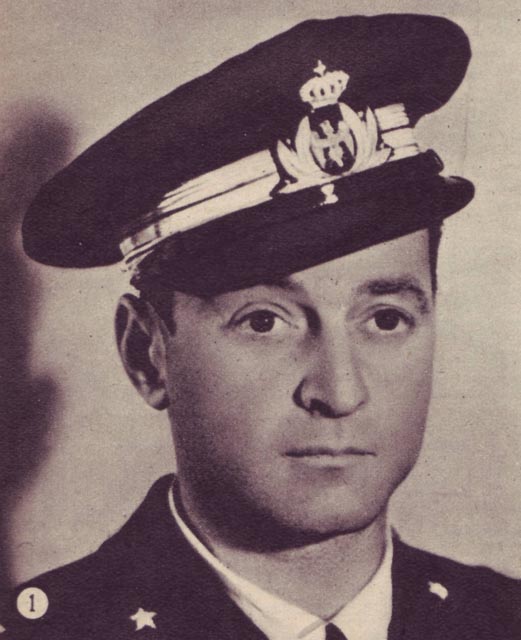
Luigi Filippi was born on 2 February 1909 at Pian di Meleto (Pesaro). On 12 November 1929, he was commissioned (in Servizio Permanente Effettivo). Capitano Ottorino Fargnoli left the command of the 364a Squadriglia, 150o Gruppo in February 1938 when Capitano Filippi took command of the unit. Capitano Filippi left the command of the 364a Squadriglia, 150o Gruppo, in February 1939 when Capitano Nicola Magaldi took command of the unit. In February 1939, the 3o Stormo was under the command of Colonello Fortunato Rolando and equipped with Fiat CR.32s (complemented with Ca.133 transports for each squadriglia). The Stormo consisted of two Gruppi; 23o and 18o. 23o Gruppo was commanded by Maggiore Tito Falconi based at Mirafori. The squadriglia commanders were Capitano Ottorino Fargnoli (70a Squadriglia), Capitano Guido Bobba (74a Squadriglia) and Capitano Filippi (75a Squadriglia). The 18o Gruppo was commanded by Maggiore Ferruccio Vosilla and based at Mondovì. In October 1939, 23o Gruppo started to re-equip with Fiat CR.42s and from November the 18o Gruppo did the same. When the war broke-out on 10 June 1940 3o Stormo was sent to the French border to take part in the attacks on southern France. On 15 June 1940 at noon 25 CR.42s from the 23o Gruppo departed from Cervere (a small town in Piedmont near the French border) to attack Le Cannet Des Maures airfield. The first group under the command of Maggiore Tito Falconi (CO of the 23o Gruppo in a CR.42 from the 70a Squadriglia) was to make the strafing attack. Capitano Filippi (CO of the 75a Squadriglia) was in this group. The unit claimed fifteen "Curtis" fighters and four old bombers that lay on the sides of the airstrip, Capitano Bobba claimed hits on three aircraft as did Sottotenente Tessera while Sergente Sala claimed to have hit two aircraft on the ground (it seems that at least three D.520s were destroyed when Dewoitine D.520 nos. 257, 294 and 304 of GC III/6 went up in flames). During the strafing attack a number of French fighters identified as “four or five Morrane” or alternatively “Dewoitine” engaged the strafing Fiats. Capitano Filippi (MM4361) was shot down by Adjutant Pierre Le Gloan of GC III/6. Filippi baled out and was captured. After Capitano Filippi’s capture, temporarily command of the 75a Squadriglia was given to Tenente Mario Rigatti. Filippi was released after the end of the French campaign. In July 1940 23o Gruppo moved to Sicily and took part in the attacks on Malta. On 9 July the 23o Gruppo became Autonomo and the first escort missions over Malta was flown on 12 July. At 09:45 in the morning of 31 July, nine 23o Gruppo CR.42s escorted a single reconnaissance S.79 over Malta. Three Gladiators took off to intercept, flown by Flying Officers Peter Hartley (N5519), Fred F. 'Eric' Taylor (N5529) and William ’Timber’ Woods (N5520). As they attacked the formation, the bomber turned away, but a dogfight began at once between the opposing fighters. A burst of fire from the guns of Sergente Manlio Tarantino’s aircraft caused the fuel tank of Hartley’s Gladiator (N5519) to explode, he baled out suffering from severe burns. Woods shot down the commander of the Italian formation Capitano Antonio Chiodi of the 75a Squadriglia, his aircraft falling into the sea five miles east of Grand Harbour. Chiodi was subsequently awarded a posthumous Medaglia d’oro al valor militare. The returning Italian pilots claimed that they had seen five Gladiators and two of them were claimed shot down. One by the above mentioned Tarantino and one by Capitano Filippi. Two more Gladiators were attacked by Tenente Mario Rigatti. Filippi took command over 75a Squadriglia after the death of Capitano Chiodi and was promoted to Maggiore on 3 October 1940. The British offensive Operation Crusader was launched in North Africa on 18 November 1941. Italian reinforcements were rushed to Libya including 157o Gruppo, which arrived at Benghazi K2 in early December with their MC.200s and Maggiore Filippi CO of the Gruppo. On 16 July, 74a and 75a Squadriglie of the 23o Gruppo CT, led by Maggiore Filippi, arrived at Abu Haggag with 18 MC.202s. The first operation to be undertaken by newly-arrived 23o Gruppo occurred when Maggiore Luigi Filippi, the unit commander, led twelve MC.202s (seven of the 75a and five of the 74a Squadriglie) on a free sweep (17:20-18:40) over the lines on 17 July. North of El Alamein fighters were seen, Filippi claiming one and Sergente Maggiore Felice Papini (74a Squadriglia) a probable, identified as P-40s. At 10:05 on 29 August, eleven Kittyhawks from 2 SAAF Squadron and eleven Tomahawks from 5 SAAF Squadron patrolled the forward areas, meeting a reported ten plus Bf 109s and MC.202s - no Bf.109s were involved in this clash. During the following combat at 09:50, the Italian pilots claimed five SAAF aircraft and one probable. One was claimed by Maggiore Filippi (CO 23o Gruppo). At 06:10 on 1 September, two formations of the 23o Gruppo Macchis, the first of eight led by Maggiore Filippi, and the second of ten led by Capitano Claudio Solaro, took off to provide cover for the ground troops south-east of El Adem. At 07:15, Maggiore Filippi and his pilots spotted 24 Bostons south-east of El Alamein and attacked their escorts claiming two P-40s shot down. These being claimed by Filippi and Capitano Mario Pinna (CO 75a Squadriglia). 3 September, following an uneventful morning sortie 19 MC.202s of the 23o Gruppo had taken off again at 12:40 to patrol over the front line. A large formation of 18 twin-engined bombers, identified as Bostons, escorted by about 35 P-40s was reported and three of the fighters were claimed as destroyed, plus two probables. Attacks were made on several others and one more was claimed damaged. Three of the claims were made by the 75a Squadriglia 30 kilometres south of El Alamein when Sergente Luigi Bozzolan claimed one destroyed, Maggiore Filippi one damaged. Five MC.202s from the 23o Gruppo, led by Maggiore Filippi, were scrambled at 11:50 from Abu Haggag on 9 October 1942. Twenty kilometres south of Daba, they met a formation of 18 ‘Bostons’ (as the British twin-engined bombers were invariably identified by the Italians) and fighters. A fight occurred during which Maggiore Filippi claimed a P-40. At 10:05 on 30 October, nine MC.202s of the 23o Gruppo led by Maggiore Filippi were scrambled. Several British bombers and fighters were met and attacked. Sergente Maggiore Felice Papini (74a Squadriglia) claimed one P-40 and Filippi two damaged. As of 8 November 1942 (on the launch of Operation Torch in North Africa), Maggiore Filippi served as CO of the 23o Gruppo CT. The unit was based at Bu Amud, Libya, and equipped with MC.202s. On 20 February 1943, Maggiore Filippi, CO of the 23o Gruppo CT, was travelling by car to Gafsa when he ran into a US outpost where he was shot by a sentry. His body was never recovered. Capitano Giorgio Tugnoli took over command of the 23o Gruppo CT. During the war he had been Commander of both the 156o Gruppo and the 23o Gruppo. At the time of his death, Filippi was credited with at least 1 biplane victory and a total of 7 (1 Gladiator destroyed in a CR.42 75a Sq and teh remainign planes P-40s flying the C.202 23o Gr.).[2] References [1] Angelucci E. and P. Matricardi, "World Aircraft, World War II – Part I", Sampson Low Guides, 1978 [2] Biplane Fighter Aces from the Second World War - Håkans Aviation Page
Håkans aviation page
 [3] Apostolo, G. and G. Massimello, "Italian Aces of World War 2", No.34, Osprey Publishing, Oxford UK, 2000
Italian Aces of World War 2

|
This is the Hasegawa C.202 in 1/48. To reproduce a real Folgore, it is necessary to take back, to drill and to block certain engravings. Helped with the plan found in the magazine usual Ali d' Italia N°22, we are going to review in photo of the various modifications to make Macchi 202. 


Continuation with the cockpit: The kit cockpit was replaced by True Details resin cockpit.
True Details Macchi 202/205 Folgore Cockpit Dtl Set - 1/48 - TD48454
The seat
 is the one from Ultracast
ULTRACAST Macchi C.202/205 Seat (with Harness) - Scale 1:48 - UC48173
with the good harnesses, the dashboard is changed for that in
 photo-etched Eduard.
Eduard 1/48 MC. 202 Folgore Detail - ED49288
The painting begins with an spraying of verde anticorrosione. The seat receives a color aluminum. All the elements of the cockpit are painted with acrylic tints Prince August. 


The partition is increased first of all with the plastic card and several holes are drilled to stick cables in thread of tin. 

On wings and join Karma, four reinforcements and gas caps are reproduced with the sticky leaf of aluminum. 

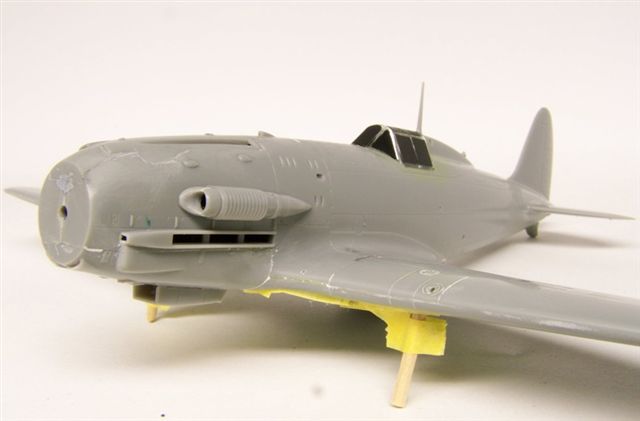
The shutter of the lap radiator was activated by two amounts, the hole of origin is filled and two holes are drilled. Linkages are added.
To reproduce the netowrk Verde olivia scuro of the plane in question of best possible, I have draw with a pencil the future rings. I do not have more than to follow the guide. Several passages are necessary to restore the good tint by paying well attention not to thicken rings. Some discreet stripes is realized on joins Karma with some ink silvered, spent by means of a fine brush. 


The continuation is classic with the second layer of varnish glittering before the weathering. Some matt varnish Tamiya in spray ends. Before tidying up definitively the aéro , smokes of escapes are realized with the black mixed with a little red strongly diluted. Maintaining here we are arrived at the last stage: the final assembly which ends with added of both test cards made plastic stretched on the hood.
Material used: - Ultracast: Exhausts, seat and wheels
ULTRACAST Macchi C.202/205 Seat (with Harness) - Scale 1:48 - UC48173
- True Detail: cockpit
True Details Macchi 202/205 Folgore Cockpit Dtl Set - 1/48 - TD48454
- Eduard Photo-etched: dashboard
Eduard 1/48 MC. 202 Folgore Detail - ED49288
- Stormo!: Italian WWII Aces Part III
Italain WWII Aces Part III Decals - STRM48003

|
Aircraft: Macchi MC.202 Manufacturer: Aeronautica Macchi S.p.A. Type: Fighter Year: 1941 Engine: Daimler Benz DB 601A-1, 12-cylinder V, liquid-cooled, 1,175hp Wingspan: 34 ft 8 1/2 in (10.57m) Length: 29 ft 1 in (8.85 m) Height: 9 ft 11 1/2 in (3.02 m) Weight: 6,480 lb (2,937 kg) (Loaded) Maximum Speed: 372 mph (600 km/h) at 18,050 ft (5,500 m) Ceiling: 37,700 ft (11,500 m) Range: 475 miles (765 km) Armament: 2 x 12.7 mm SAFATs (0.5 in) Crew: 1 |


|
|
|
|
|
|
|
|
|

|
|
|


|


|
|
|
|
March, 2011 STORMO! © 2011 |