|
Scratch Built 1/32 Reggiane Re.2000GA (Grande Autonoma) Long Range Fighter by Luca Bossi 
|

|
|
|

Click the STORMO! Eagle to return to the Gallery |
|
Background The Reggiane 2000 was a modern aircraft constructed entirely of metal under the general direction of the Ing. Longhi. Following Longhi’s experiences in the United States he began design of this stellar aircraft; introducing new construction techniques to the Reggiane firm such as the use of aluminum and the construction of wings as a single piece. Looking at the aircraft there are some obvious similarities to the Seversky P- 35; however the Re. 2000 was significantly more powerful and modern in its design. Comparative tests against the Me.109 E indicated the Re.2000 was more maneuverable and more stable in flight; in combat simulations with the Me.109 the Re.2000 demonstrated its marked superiority. However unfortunately the Falco’s engine, as it was christened, a Piaggio P.IX R.C. 40, was not always reliable; a handicap of the aircraft that it would carry to the end of its career. Unfortunately in spite of test flights and results the Regia Aeronautica was still undecided, pointing out the location of the fuel tanks represented a serious risk to pilots (a similar issue with the P-47); this particular problem however did not deter foreign interest in the aircraft which included purchase orders from Sweden, Hungary and Britain. The purchase order from Britain would eventually be canceled because of war. Following the construction of the prototype, there followed four variants of the aircraft: an interceptor, a catapult launched version for the Regia Marina, the ‘bis’ and the G.A. (Grande Autonomia, Long Range Fighter). The ‘bis’ version was a transition aircraft before the definitive G.A. was put into production, brandishing a large additional fuel tank located behind the pilots seat as well as replacing the all glass canopy with the typical Italian scalloped headrest for safety purposes. The Re. 2000 was used by the newly formed Experimental Squadron of the 23o Gruppo, 3o Stormo based at Comiso and the 377a Sq., an Independent Squadron based at Palermo, Bocca di Falco Airforce Base and also with a section at Trapani. The 377a Sq. used the Re. 2000 extensively, and as it turned out was the only RA operating unit completely equipped with the fighter, having received the entire assignment to the Regia Aeronautica (18 aircraft); except those catapult types destined for use on the great battleships. From their deployment in Sicily, the Re. 2000 operated against Malta, dividing its missions into convoy escort, ground attack, the attacking of ports and interception.[1] Grande Autonoma The difficulties of supplying the forces in Italian East Africa with modern material became critical in 1941; the air shipment of dismantled CR.42 fighters in specially equipped S.M.82 transports was partially successful, but it was considered the next logical step was to send modern fighters of acceptable performance in direct flight from Italy to Ethiopia. The Macchi C.200 was ruled out on grounds of range, and the only available aircraft for adaption for longrange ferry flights was the Re.2000. By scaling off the cells of the outer wing structure, it was possible to raise the tank capacity to 328 Imp. gallons. To perform practical tests, and considering the growing interest of the Regia Marina (Italian Navy) in the possibility of obtaining a modern long range reconnaissance fighter to replace the dangerously obsolete Ro.43 and Ro.44 machines on the catapults of the larger ships of the Fleet, the Italian Government seized 28 export machines off the assembly lines (20 being originally destined for Hungary, eight for Sweden), extra aircraft subsequently being built to make up both orders. Successful tests of the Re.2000 G.A. (Grande Autonomia, Long Range) were performed by Col. A. Mantelli, a pilot who had won fame in the Spanish Civil War; but the fortunes of war in East Africa put an end to the ferry-flight project, for which a number of pilots had already volunteered. To perform an operational evaluation of the fighter, five of the seized aircraft were assigned to the 74° Squadriglia of the 23° Gruppo, 3° Stormo C.T. in Sicily early in 1941. Subsequently, in August of that year, the 377° Sq. C.T. was formed at Milo (Trapani), to which unit the aircraft of the 74° Sg. were transferred; in the meantime three of the five had been modified to the long range configuration; and twelve other aircraft of the impounded batch were also supplied to the squadron, already modified. Initially attached to the 23° Gr., the squadron became Autonomous in September 1941 and was used primarily in the patrol and convoy escort roles, operating from Milo, Comiso and Pantellaria. Of the remaining eleven seized machines, one was used as a structural airframe for the construction of the sole prototype of the Re.2003 two-seat reconnaissance aircraft; and the last ten were completed as Re.2000 Series III, fitted with catapult pick-up points and destined for the Air Branch of the Navy, known as the Aviazione Ausiliaria per la Regia Marina. (It is interesting that all pilots of machines assigned to this service were Air Force personnel; only the observers in multi-place machines were naval officers). Meanwhile, the 377° Sg. operated in Sicily; in March 1942 the unit moved to Boccadifalco, the airport at Palermo, for the air defence of the town. Commanded by Capt. L. Marcolini, the squadron was augmented in this period by the supply of a few CR.42’s. In the following September the unit gave up its Re.2000’s, after 322 operational missions, for Macchi C.200’s. The surviving machines were ferried by squadron personnel to the Reggiane plant for “navalising”. Modifications in the field during the aircraft’s service with the 377° Sg. included the deletion of the small bomb bay, and the locking of the tail wheel to counteract a certain tendency to swing on landing. It should be noted that in the last months of the units operations with the Reggiane, a small number were received with long range tanks and incorporated the features of the Series III model: solid headrests with scalloping, different radio and a new windscreen. The ten machines concerned, ordered to cover attrition within the squadron, were the only ones to be delivered from an order of thirty. Including the 28 machines seized and the two prototypes, the total number of Re.2000’s operated was 40 aircraft.[2] References [1] Angelucci E. and P. Matricardi, "World Aircraft, World War II – Part I", Sampson Low Guides, 1978 [2] Cattaneo, G., "The Reggiane Re.2000", Number 123, Profile Publications, Surrey, England, 1966
PROFILE Publications No. 123 - The Reggiane Re.2000
 [3] Punka, G., "Reggiane Fighters", Aircraft Number 177, Squadron Signal Publications, Carrollton Texas, 2001
Squadron/Signal Books - Reggiane Fighters in Action

|
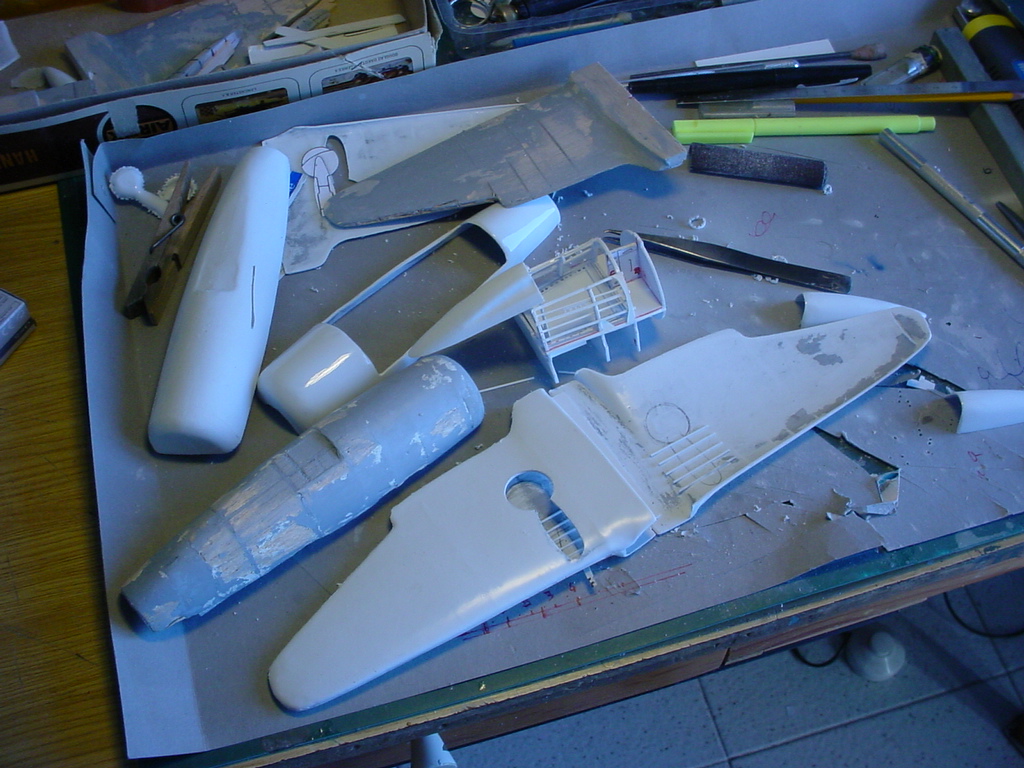
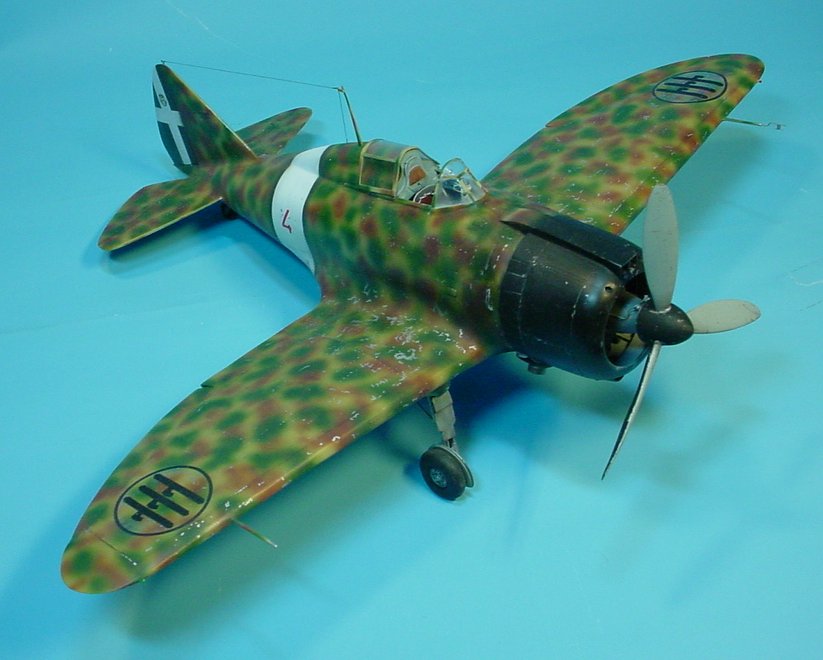
This is my scratchbuild in vacuum built 1/32 Scale Reggiane Re 2000 GA. The vertical and orizontal rudder, pilot seat and wheels, are resin copies from the Pacific Coast Models RE 2005. This is a RE 2000 GA, of 23° Gruppo Caccia Terrestre, 377a Sq. CT, 1a Sezione (black engine), Catania airfield (Sicily – November 1941). Colours and Markings The camouflage reference is show in “Sergio Govi, il caccia RE 2000 e la storia delle Reggiane , Giorgio Apostolo Editore – Pg 56“ and “Squadron Signal in Action Series n. 177” in annex . The airplane is shown with a dark band around the white fuselage band and dark mobile rudder. The airplane was in the standard metropolitan colors in "Verde Scuro Tipo 2" and grey. After the factory modification in GA ( long range ), the airplane recived in Palermo Boccadifalco , a camouflage similar to C1B preserving Regia fuselage band and Savoia rudder cross, and yellow engin cooling band , re-painted in black after a few days, in Trapni ora Catania airport. - Giallo Mimetico 1-3 = Humbrol H94 - Verde Mimetico 3 = Tamya XF26 - Marrone Mimetico 1-2-53193 = Tamya XF68 - Grigio Mimetico = Tamya XF19 References - Sergio Govi, il caccia RE 2000 e la storia delle Reggiane, Giorgio Apostolo Editore. - Squadron Signal in Action Series n. 177 - Reggiane Fighters. - Nicola Malizia “IL REGGIANE 2000“ Edizioni dell’Ateneo e Bizzarri. - Ali e Colori n. 6 - Caccia Reggiane - La Bancarella Aeronautica ,Sergio Brioschi drawings. - a lot of foto.


And here's the finished model.


|
Aircraft: Caproni-Reggiane Re.2000 Manufacturer: Officine Meccaniche 'Reggiane' S.p.A. (Caproni) Type: Fighter Year: 1939 Engine: Piaggio P.XI RC 40, 14-cyclinder radial, air-cooled, 986hp Wingspan: 36.0 ft 1 in (11.0 m) Length: 26.0 ft 2 1/2 in (7.99 m) Height: 10.0 ft 6 in (3.20 m) Weight: 6,290 lb (2,850 kg) (Loaded) Maximum Speed: 329 mph (530 km/h) at 16,400 ft (5,000 m) Ceiling: 34,450 ft (10,500 m) Range: 870 miles (1,400 km) Armament: 2 x 12.7 mm (0.5 in) BREDA-SAFAT machine guns Crew: 1 |


|
|
|
|
|
|

|
|
|

|

|
|
|
|
March, 2011 STORMO! © 2011 |