
Dear all,
I have another question:
- The first 12 S.79s – belonging to the first production series – arrived in Spain with the "classic" livery of three-color, hard-edge transverse/diagonal bands (livrea a bande trasversali/diagonali a bordi netti di tre colori), about which I have little to add or ask.
- Many of these aircraft and others sent later (still received by the units with the diagonal band livery) were repainted on the field:
some in likely in two colors, one dark – interpreted as green – and one light – interpreted as yellow; the yellow has been interpreted as the base color and the green as the subsequent color. Some interpretations show these aircraft repainted with a few sparse brown spots, in addition to the predominant yellow and green.
other S.79s received a much darker and more complex livery, with the banding pattern more or less preserved but covered with very dense patches.
The camouflage patterns applied in the field to the S.79s and S.81s underwent more or less the same evolution.
- The last batch of S.79s, sent to Spain in the summer of 1939, wore the new factory livery with dense, three-color spots (macchie fitte a tre colori).
I rely primarily on the reconstructions advanced in "I colori dell'Aviazione Legionaria", published by Gli Archivi Ritrovati; these hypotheses are confirmed — or at least not contradicted — by the volumes Ali d'Italia and the Dossiers and Briefings of Storia Militare.
My questions are:
1) Are the hypotheses regarding the colors applied in the field to the S.79s in Spain, and more generally to Italian aircraft in Spain, supported by written documents or color photographs? Or were they hypothesized solely because of their "similarity" to the factory colors applied in Italy? In particular, if there are no written documents or color photographs, why is the use of gray excluded, as it is believed to be present on the multi-colored patchwork liveries applied to approximately contemporary aircraft? Why, given the Spanish environment, was green hypothesized to be the dark color and not brown? Wouldn't a yellow and brown camouflage blend better with the landscape than a green and brown one?
2) Is there evidence that the last batch of S.79s received the three-color dense patchwork livery (type A grid camouflage pattern for spring) from the factory, and therefore, in practice, the S.79 line transitioned from the diagonal-banded livery (bande diagonali a bordi sfumati) to the "definitive" three-color dense patchwork livery (excluding, for Spain, the S.79s produced with the diagonal-banded livery with blurred edges), not one of the hypothesized "preliminary" two-color patchwork liveries—type B summer/early autumn or C late autumn/winter?
Thanks
Mario
S.79 in Spain

Re: S.79 in Spain
92 S.79 were delivered to the Aviazione Legionaria as follows:
3 - February 1937
2 - March
9 - April
5 - August
12 - September
12 - November
15 - January 1938
8 - April
26 - July
61 were purchased by the Aviacion Nacional in 1937-38
Spain:
- No S.79s were lost due to enemy fighters in 100 aerial engagements w/ Republican fighters.
- 4 were lost to AA (2 that collided + 1 where bombs detonated prematurely + 1 that was actually struck).
- 8 lost in accidents but no casualties.
- 2500 missions, 20,000 hrs.
1) The CMPR hypotheses regarding colors of Italian a/c in Spain were based on the DGCA note 8/9/37 (different camouflage patterns for three different seasons: A - spring, B - summer/autumn, C - autumn/winter). There was also an attachment with schemes that have not yet been discovered but we should go by what Virginio Tosco says here, who would have seen the above mentioned attachment: green on yellow for scheme A, dark green on light green for scheme B, and dark green and brown on light green for scheme C. I don't think planes destined to Spain were built specifically for Spain, the planes were taken off the assembly line and sent to Spain as they were finished according to the policies in front of them. The CMPR study is now quiet old, although still valid (we try to add to it here in our ColorGuide), and we know more today than they knew back then. In regard to the Grays, see Stefano's Vito Charts on this site Imgs 36-39.
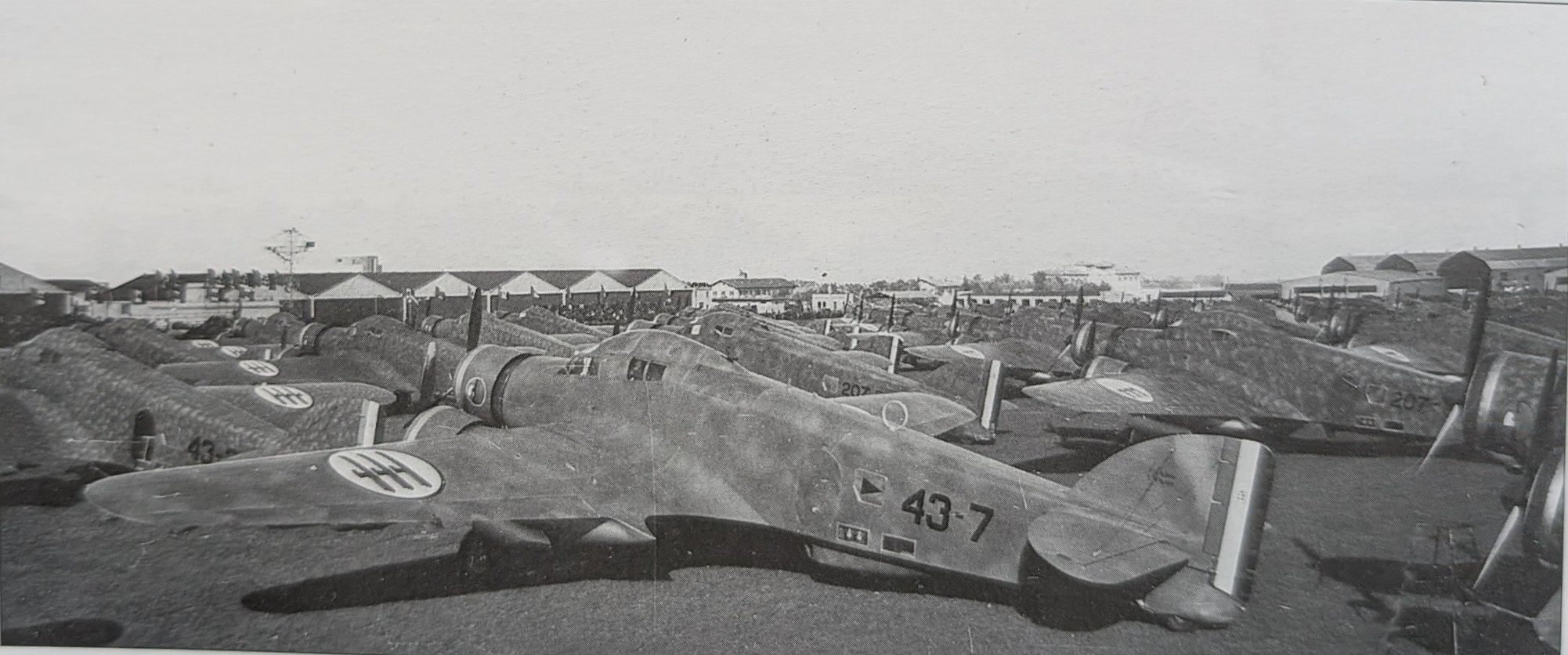
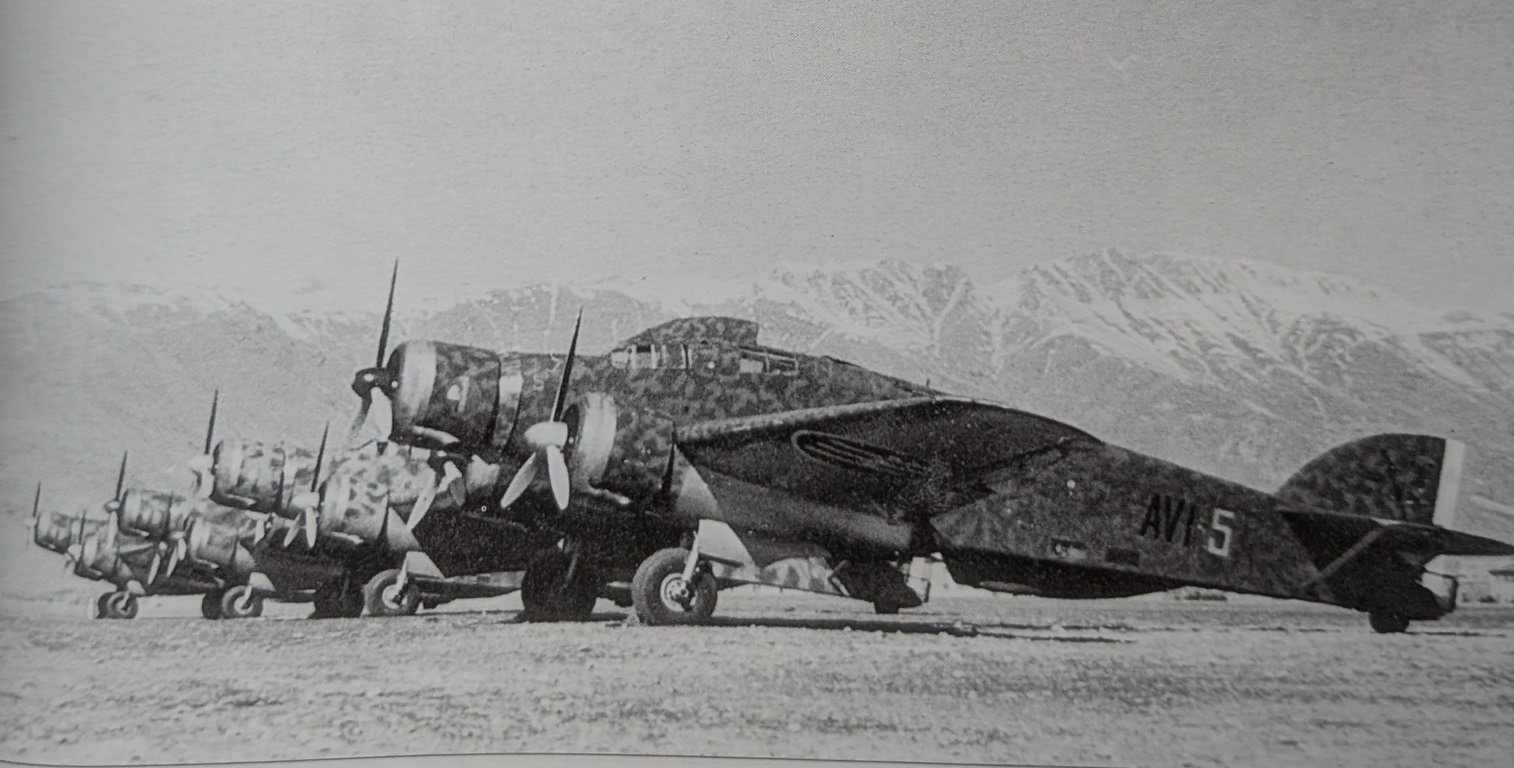
2) The hard edged banded schemes were found to be not as effective (in Spain) as the mottled schemes and thus the shift. The Italians believed they were more likely to lose an a/c on the ground than in the air, and both in Spain and WWII this was shown to be the case. There's a pre-war photo of a large collection of 33o Stormo S.79s with the 2 and 3 tone camo schemes and another photo of 59a Sq S,79s with CMPR C3. CMPR C2, C3 and C5 schemes can all be confirmed.
S.79s 33o Stormo
S.79s 59a Sq
3 - February 1937
2 - March
9 - April
5 - August
12 - September
12 - November
15 - January 1938
8 - April
26 - July
61 were purchased by the Aviacion Nacional in 1937-38
Spain:
- No S.79s were lost due to enemy fighters in 100 aerial engagements w/ Republican fighters.
- 4 were lost to AA (2 that collided + 1 where bombs detonated prematurely + 1 that was actually struck).
- 8 lost in accidents but no casualties.
- 2500 missions, 20,000 hrs.
1) The CMPR hypotheses regarding colors of Italian a/c in Spain were based on the DGCA note 8/9/37 (different camouflage patterns for three different seasons: A - spring, B - summer/autumn, C - autumn/winter). There was also an attachment with schemes that have not yet been discovered but we should go by what Virginio Tosco says here, who would have seen the above mentioned attachment: green on yellow for scheme A, dark green on light green for scheme B, and dark green and brown on light green for scheme C. I don't think planes destined to Spain were built specifically for Spain, the planes were taken off the assembly line and sent to Spain as they were finished according to the policies in front of them. The CMPR study is now quiet old, although still valid (we try to add to it here in our ColorGuide), and we know more today than they knew back then. In regard to the Grays, see Stefano's Vito Charts on this site Imgs 36-39.
2) The hard edged banded schemes were found to be not as effective (in Spain) as the mottled schemes and thus the shift. The Italians believed they were more likely to lose an a/c on the ground than in the air, and both in Spain and WWII this was shown to be the case. There's a pre-war photo of a large collection of 33o Stormo S.79s with the 2 and 3 tone camo schemes and another photo of 59a Sq S,79s with CMPR C3. CMPR C2, C3 and C5 schemes can all be confirmed.
S.79s 33o Stormo
S.79s 59a Sq

Re: S.79 in Spain
A late, but still valid thank to you Editor.
Mario
Mario