|
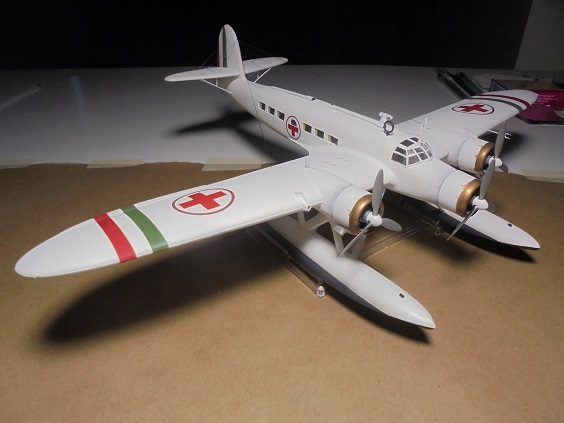
BroPlan 1/72 CANT Z.506C Civil Transport (Soccorso) by Richard Mendes |
|

Click the STORMO! Eagle to return to the Gallery 
|
|
The Cantieri Aeronautici e Navali Triestini (CANT) Z.506 Airone (Heron) was amongst the largest wooden aircraft to see combat during the 20th Century. Designed by Filippo Zappata (1894-1994) as a transport and postal aircraft, militarized Airones were amongst the best WWII seaplanes, flying reconnaissance, bomber and air-sea rescue missions with the Regia Aeronautica Italia (RAI), Regia Marina (RM), Aeronautica Nazionale Repubblicana (ANR), Aeronautica Cobelligerante del Sud, Aviación Nacional Espania, the Luftwaffe and the British Royal Air Force, some Z.506S’ flying air-sea rescue missions till 1959. The Z.506 derived from the larger and heavier Z.505 seaplane sole example which first flew on July 10, 1935 powered by three Isotta Fraschini Asso XI in-lines was designed as a 12 to 14-seat transport first flying on August 19, 1935 powered by three Piaggio Stella IX radials production commencing in 1936 as the Z.506A powered by Alfa Romeo 126 radials. The wooden fuselage was covered in tulipier lamellas, mainwings three box-type wood spars linked by wooden wing-ribs covered in plywood, duraluminum floats covered in chitonal. The first civil Z.506A Airones flew with Ala Littoria militarized Z.506Bs entering service in 1939 with the RAI and RM powered by Alfa Romeo 127 radials manufactured by Cantieri Riuniti dell'Adriatico and CANT as well as Piaggio under license. Total Airone production between 1935 and 1943 was approximately 346 aircraft including the prototype, 314 Z.506Bs and Z.506S’ (some Bs were converted to S’), civil Z.506As and Z.506Cs constituting the balance. One Z.506 was converted into a land plane for CANT Chief Test Pilot Mario Stoppani (1895-1959) to attempt an endurance record but was aborted because of bad weather. The militarized CANT Z.506B had a crew of five; defensive armament one dorsal mounted 12.7mm Breda-SAFAT, one ventral, two fuselage beam mounted 7.7mm machine guns, offensive 2,600lbs bombs, mines or one 1,800lb torpedo in an internal bomb bay. |

|

|

|
|
|
|
|

|

|

|
|
In Civil Use Ala Littoria airline placed an order for a first batch of floatplanes in December 1934 and introduced five aircraft into service during 1936 powered by Wright Cyclone SGR-1820-F52A engines giving 770 hp. The first production version provided seating for 12 passengers and 4 crew members. Cruising speed was 310 km/h at 2800 m (194 mph at 8500 feet). Ala Littoria even before obtaining the required R.A.I. (Italian Civil Aviation Register) certification had already been testing the prototype I-CANT on postal service on the Rome-Syracuse-Bengazi line as from 1 June 1936. The first production aircraft made its first flight on 31 January 1936, entering into service with Ala Littoria at the end of June on the same route. Another aircraft from the first construction batch, registered I-POLA was converted into a landplane by mounting a fixed landing gear from a SIAI S.81 bomber, in order to try breaking a distance record taking off from Cagliari-Elmas airport. However the attempt was first delayed due to bad weather and later cancelled when an urgent requirement by Ala Littoria to start its service use could no longer be delayed. So it was eventually converted back to its original seaplane configuration. During 1937 two further aircraft were delivered to Ala Littoria in 12 passenger configuration, one of them being fitted with the Wright Cyclones and the other one, registered I-LERO, with the 750 hp Alfa 126 RC34 engines, driving metal propellers with in-flight variable pitch. Between 27 and 28 May 1937, Ala Littoria's pilots Mario Stoppani and Carlo Tonini remarkably broke ten international records while flying I-LERO: on the 27th Stoppani led the floatplane taxying Monfalcone, with a maximum weight excess of 15,000 kg and its floats heavily submerged, then took off in 62 seconds instead of the 26 normally required with a full load take-off run. The trial consisted repeating 10 times the Monfalcone-Rimin-Senigallia route, with the last 200 kilometers covered running twice the Monfalco Punta Tagliamento Lighthouse-Pun Salvatore Lighthouse route, for a total 5,200 km. Flying time was approximately 17 hours and arrival was at 9:54 a.m. on the 28th. The speed records with 1,000 kg payload, previously held by I-CANT both on 1,000 and 2,000 km, reducing speed to 322.04 and 319.78 km/h respectively. Three new speed records, the 5,000 km distance with up to 1,000 kg payload, were also set at an average speed of 308.24 km/h, as well the seaplane distance record on a fixed circuit, now established at 5,200 km. At that time the Cant 506 broke as many as 14 records, out of the 23 specified by the F.A.I. (Federation Aeronautique Internationale) for the 'C.bis' class, while C.R.D.A as a company held 18 of them. As I-LERO obtained these records it was obviously realized that they virtually included with a safe margin, the possibilty of breaking also the flight distance record in a straight line, by simply converting the unused payload into extra fuel. However, to attempt this new record, it was deceided to modify a military version of the plane then in the development stage. A second construction batch of float planes, designated Cant Z.506C, was fitted with a 14 passenger cabin and featured a strenghtened structure with increased payload and fuel. This version used three Alfa Romeo 126 RC1O engines providing 800 hp and featured an increased range and the adoption of the same strenghtened tailplane as already designed for the military version Cant Z.506B. The first five 'C version' (Civil) aircraft were placed into service during 1938 and the first plane of this production batch I-ALAL, easily recognized by its windowless fuselage, was used for experimental flights. Between 20 and 26 March 1937, in order to try the South American routes I-ALAL flown by Carlo Tonini and Ing. Umberto Klinger, president of Ala Littoria, made a ferry flight from Cagliari to Buenos Aires via Gambia and Bahia returning back via Rio de Janeiro, Natal, and Dakar, and finally arriving at Lido di Roma on 13 April, having flown a total of 24,000 km at an average speed over 300 km/h. From 1 February 1939 the Cant Z.506s replaced previous types on the Rome-Marsala-Tripoli route and were used on a new three-weekly direct flight from Rome to Barcelona from 8 October 1939. On June 1940 17 aircraft were on charge with Ala Littoria with three more expected for delivery during 1941; four more aircraft were used by the Air Ministry. When Italy entered the war some air-sea rescue squadrons, namely the 612a, 613a and 614a Squadriglias, were issued with some Cant Z.506 / 506Cs, while later in the war more aircraft of the civil version were converted for use as rescue planes, adding rescue and transport equipment for transport of wounded. On 13 October 1940 the Genio Aeronautico (Air Force Engineers Corps) placed an order with C.R.D.A. for 12 more Cant Z.506Cs (Regia Aeronautica's Serie XI), intended to be used with Nuclei Comunicazioni (Ferry and Liason Units), destined for liason service all over the Mediterranean theatre during the war. These aircraft wore both the M.M. (military serials) and the civil registration, reflecting a common ownership shared by the Air Ministry and Ala Littoria, maintaining as well the documents of the civil register released by R.A.I. The last civil aircraft was delivered on 10 December 1942 bringing the total manufactured by C.R.D.A. to 38 Cant Z.506 /506Cs, including the prototypes ordered by the Air Ministry, 23 aircraft for Ala Littoria and 12 for military use by the Nucleo Comunicazioni. As late as August 1943, 12 aircraft still remained in service with Ala Italiana (as Ala Littoria was renamed after the fall of the fascist government on 25.7.1943). After the Italian Armistice on 8 September 1943, all aircraft of the type left north of the front were flown to Trieste to be used for air services in the Adriatic Sea, and were allocated to the K.M.I. Stab Marine Adria-Abteilung 6 - Trieste. While ten Cant Z.506/ 506Cs resulted operational on the Venice-Trieste-Fiume-Zara route only one Cant Z.506C, I-DANO M.M.60637 eventually survived the war remaining in force with the Aeronautica Militare. Source: S. Zorini, Ali D'Italia C.R.D.A. CANT Z.506 #5, La Bancarella Aeronautica, 1997 |

|
| With the outbreak of war many Ala Littoria CANT Z.506C were converted and used for air-ambulance flights (soccorso). |
|
|
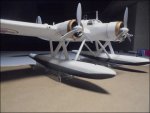
The CANT Z.506C designed by Filippo Zappata (1894-1994) was the last airliner variant of the Z.506, 38 to 40 aircraft built many impressed into Regia Aeronautica Italiana (RAI) WWII service. The 2000-vintage BroPlan MS-44 CANT Z.506C vacuformed fuselage conversion kit requiring a 1983-vintage (Scalemates.com claims 1986 though remember otherwise) SUPERMODEL 10-015 or 2015-vintage Italeri 1360 Z.506B kit donor parts is the only one available in any scale, lacking water decal sets for modeling an aircraft in standard RAI livery as well as a civilian-registered military transport that depicting an overall white-painted air ambulance was built. Already having built the SUPERMODEL Z.506B experience was drawn upon building the Z.506C composite model particularly with respect to inner fuselage-float bracing struts being centimeter too short those provided with the Italeri kit duly lengthened with cut-styrene plastic shims each taking hours to fabricate. Liberally employing updated Italeri kit parts particularly with respect to the cockpit, save for gluing in place either sides of cabin windows generically-shaped window shades fabricated from cut styrene sheet plastic pieces spray painted Humbrol 148 Matt Radome Tan, no photographic references readily could be found of an air ambulance passenger cabin to scratch build parts for. Fuselage-main wing joins necessitated having to cut off, glue together, sand-shape, test fit and glue in place the aft mainwing roots of the Italeri kit followed by gluing main wings on the fuselage, putty-filling and sand-finishing all joins, the most laborious and difficult part of the entire model build!
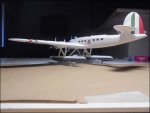
Painting the model was straightforward; fuselage and engine cowling interiors 50/50 Humbrol 78 Matt Cockpit Green + Testors Flat White + 36% White scale shading enamels replicating Verde Anticorrosione, all exteriors Flat White, floats below water line Testors Flat Black and White "special mix" weathered with Flat Black and White "special mix" Polyscale acrylics (matt finish desired, no clear semi-gloss lacquer over spray), various Testors Aluminum, Black, Bronze, Olive Green, Red, Rubber, Rust et. al. flat enamels employed as detailing colors. Other than the off-color as well as unusable SUPERMODEL kit and unobtainable Pronto Model 72/534 Z.506B decal sets none could be found for Z.506C air ambulances Tootsietoy Midgetoy Ambulance Decals Red Cross On Round Surface Scale Models stick-ons in combination with inkjet-printed on paper ring surrounds positioned in place with white glue employed instead latters off-color due to print registration issues though nonetheless aesthetically pleasing. Because of uncertainty based on very few period photographs of Z.506C air ambulances whether House of Savoy crests were universally on tri-color rudders none were applied.
|


Aircraft: CANT Z.506C Manufacturer: Cantieri Riuniti dell'Adriatico Type: Civil Transport Year: 1938 Engine: Three Alfa Romeo, A.R. 126 RC 10 9-cylinder radial, air-cooled, 800 hp each Wingspan: 86 ft 11 in (26.50 m) Length: 62 ft 7 3/16 in (19.08 m) Height: 23 ft 3 17/32 in (7.10 m) Weight: 26,455 lb (12,000 kg) (Loaded) Maximum Speed: 230 mph at 9,186 ft (370 km/h at 2,800 m) Range: 1,243 miles (2,000 km) Passengers: 14 Crew: 4
|
|
|








|
|
|
|

|


|


|
|
|
|
|
|
|
|
December, 2021 STORMO! © 2021 |