|
Special Hobby 1/48 FIAT BR.20A Corsa (Racer) I-8 by Vince Fiore |

|

Click the STORMO! Eagle to return to the Gallery |
|
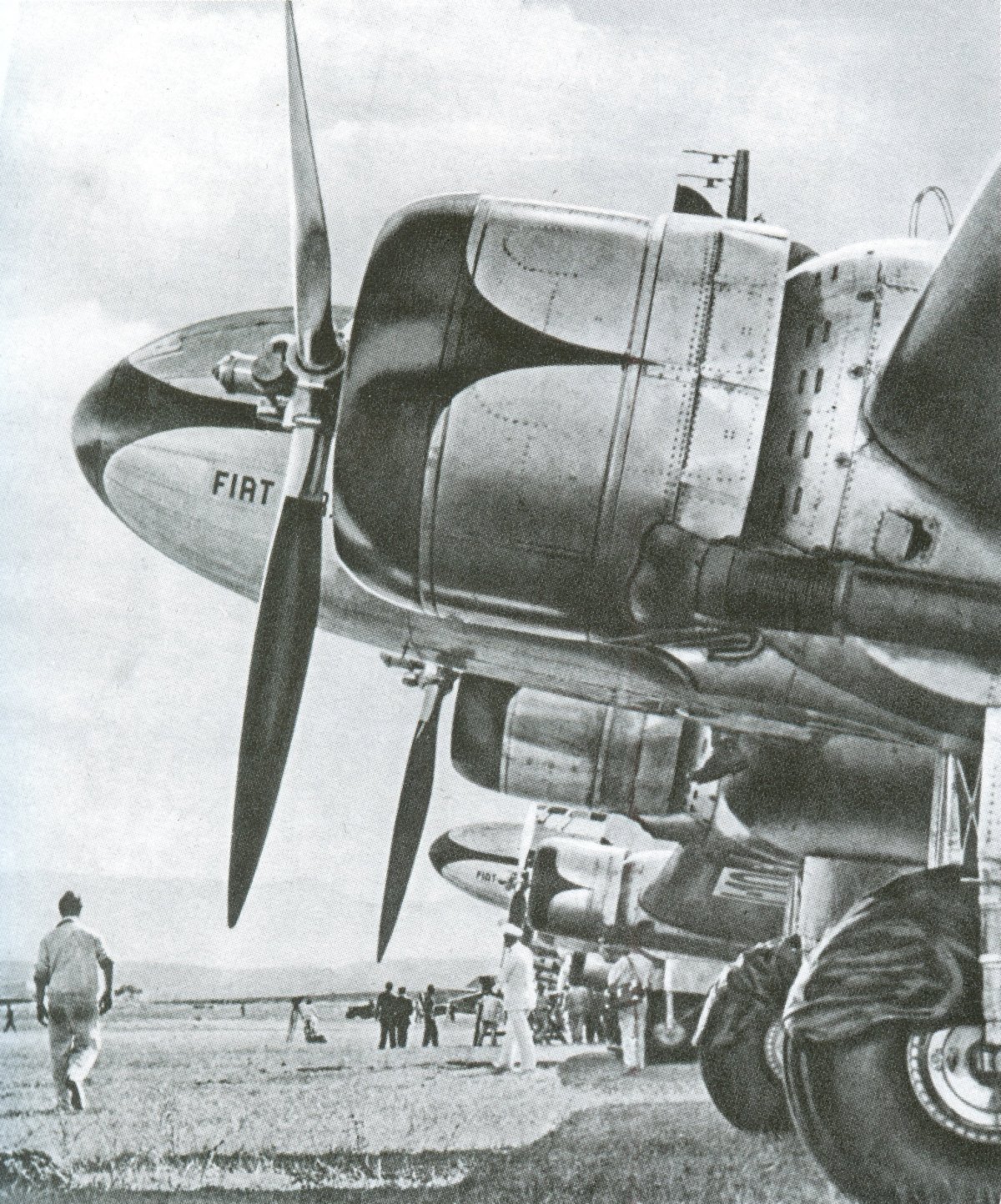
In 1937 the Fiat company was trying to actively promote their new bomber by exhibiting an early production machine (M.M. 20308) at the 2nd International Aviation Exhibition in Milan. Meanwhile, hoping to attract some export orders and with an eye to international competitions, they also designed a special racing version, designated the BR.20A, similar to what SIAI-Marchetti had done with the S.79. The first two aircraft from the third production batch (MM. 21241 and 21242) were taken off the production line and delivered, after having been converted to the BR.20A standard, to 12o Stormo at Guidonia in order to enter, together with six S.79 racers, the lstres-Damascus-Paris air race held on August 1937. Stripped of any armament, their weight was reduced to little less than 6,350kg, even if then the increased fuel quantity eventually brought back the full weight to 12,750kg, with a maximum speed of 430 km/h. A new, solid nose section was also designed, offering better aerodynamic penetration to the air frame. Both aircraft retained the military serial numbers receiving also, respectively, 1-8 and 1-10 race numberals. Onboard 1-8 (also civil registered I-ROBO for the race) took place Lt.Col. Rolandi and Lt.Col Bonini with W.Off Rossi, while 1-10 (registered 1-GAQU) was flown by Lt. Col. Gaeta and Lt. Col. Questa, with Lt. Zoppi and Sgt. Bordoni completing the crew. On 18 August 1937 the first leg was successfully flown, from Istres to Damascus, at a remarkable average of 385 and 400 km/h respectively, even if later an unlucky sequence of shortcomings affected the engines during the return flight, forcing both of BR.20s to leave the race: one landing at Ronchi dei Legionari, while the second plane ended up in a belly landing at Punia Sabbioni, near Venice.
Source: P. Waldis and F. Pedriali, Ali D'Italia No.23, Fiat Br.20, La Bancarella Aeronautica, Torino, 2006. |

|
|
|
|
|

|
|
|
This build is a conversion of the Special Hobby 1/48 Fiat BR.20 to the Fiat BR.20A, one of two BR.20A racers entered in the Istres-Damascus-Paris in August 1937. I will say I had no drawings for this conversion, therefore there may be some errors in the contours of the nose. The first thing I did was to remove the lower front of the fuselage. Next, with this done I glued the fuselage together. When it had dried I glued a piece of sheet plastic to the lower front of the fuselage. I then cut a circle of plastic card and inserted it where the top gunner's position is located. I then filled the void with milliput in these two areas. I moistened my fingers and proceeded to contour the mil put to the approximate contours. I did the same for the nose. I then put it aside to dry overnight. The following day I sanded everything to shape. I proceeded to glue the cabin clear part in place. This was then blended with the fuselage. The rest of the build was proceeded with. All went well. I primed everything with MRP. Any imperfections that showed themselves were sanded again and then primed for the second time. This was repeated until I was happy with the finished product. Both these planes were completely covered in a metal skin. Because MRP is such a fantastic product I did not have to put on a clear coat to affix the decals. The only decal not supplied was for the forward fuselage. This was painted freehand with Misterkit acrylic paint. I used Italian flag red which was a perfect match with the red of the decals. It is far from perfect but I am happy with it hope you like it and enjoy it. |
Aircraft: Fiat BR.20 Manufacturer: Fiat S.A. Type: Bomber Year: 1937 Engine: Two Fiat A.80 R6 41, 18-cylinder radial, air-cooled, 1,000 hp each Wingspan: 70 ft 8 in (21.53 m) Length: 52 ft 10 in (16.10 m) Height: 14 ft 1 in (4.30 m) Weight: 21,850 lb (9,900 kg) (Loaded) Maximum Speed: 286 mph (460 km/h) at 16.400 ft (5,000 m) Ceiling: 29,500 ft (9,000 m) Range: 1,860 miles (3,000 km) Armament: 3 machine guns; 3,527 Ib (1,600 kg) of bombs Crew: 5 |
|


|


|


|
|
|
|
|
|
|

|
|
|
|
|
|
|
|
|
July, 2021 STORMO! © 2021 |