|
Maggiore Antonio Vizzotto
Born in La Maddalena (Sardinia) on 22 June 1909, son of Valfredo Vizzotto and Adalgisa Campus. Campus was born in Sassari,
and graduated in mathematics in Pavia. At a young age the family moved to Milan, where the mother had her own publishing house, while
the father taught mathematics in Pavia. In 1928 Anonio obtained his scientific high school diploma from "Vittorio Veneto " high school
and immediately afterwards submitted an application to be admitted to the Allievi Ufficiali course at the Regia Accademia Aeronautica at Caserta.
Moving to Caserta at the famous Reggia he began the VI Corso Falco and was able to fly a Ansaldo A.300 at the Capua airport. In 1931 he obtained
second lieutenant and his pilot's license and the following year, at the end of the four years of study, he obtained the military pilot license and
promotion to lieutenant. Assigned to the fighters he carried out the first period of training at the school of Aviano, flying a Fiat CR.20B and
Breda Ba.19 biplanes. At the end of the course he was sent to the 2nd stage piloting school of Castiglion del Lago. At the beginning of 1933
he took up service with 1o Stormo Caccia Terrestri in Campoformido equipped with the Fiat CR.20.
In 1934 Vizzotto was sent to the 201a Squadriglia da Bombardamento Marittimo dello Stormo Misto "Egeo" in the Dodecanese, a unit essentially
equipped with seaplanes and at Lero airbase flew the Dornier Wal seaplane. In 1935 he tarnsferred to the 161a Squadriglia da Caccia Marittima,
equipped with the Fiat CR20 Idro. In June 1936, having been promoted the rank of captain Vizzotto returned to Italy to take up service with the
367a Squadriglia of the newly established 53o Stormo at Torino-Mirafiori, a unit equipped with the new Fiat CR.32 fighter. On 1 July of the same
year he assumed command of the newly formed 368a Squadriglia, intended for the training of pilots, to be carried out at Levaldigi airfield,
in the province of Cuneo . The outbreak of the civil war in Spain was followed by a growing commitment of the Regia Aeronautica in support
of the nationalist forces. At his request, he was sent as a volunteer to Spain arriving there on 27 September 1937.
The Spanish Civil War and World War II
As soon as Vizzotto arrived in Spain he took command of the 33a Squadriglia, VI Gruppo Caccia Terrestri "Leonello" equipped with Fiat CR.32s.
Vizzotto's combat debut took place in October and between the end of 1937 and the beginning of 1938 his squadron participated in numerous missions.
During the battle of Teruel he was awarded a Silver Medal for Military Valor. In the spring his unit was heavily engaged during the Nationalist
offensive in Aragon for which he received a second Silver Medal for Military Valor followed in June of the same year by a Bronze medal for military
valor Returning to Italy on June 15th he married Maria Cremon in Milan on the 23rd of the same month. Vizzotto assumed command of the
362a Squadriglia, 24o Gruppo, 52o Stormo Caccia Terrestre in Ciampino-Sud still equipped with the Fiat CR32. Shortly afterwards the squadron
was re-equipped with the more modern Fiat G-50 Freccia monoplane with which the commander organized an aerobatic team.
On 10 June 1940, when the Kingdom of Italy entered WWII the squadron was deployed on Sarzana airfield in Liguria. During the brief conflict with
France the unit carried out protection cruises against possible dangers from Corsica and after the French armistice, training and surveillance flights on
the Tyrrhenian coast. In February 1941 Vizzotto was in command of 371a Squadriglia equipped with the Aermacchi C.200 Saetta destined to operate on
the Greek-Albanian front. The squadron 152o Grppo CT was absorbed into 150o Group CT at Valona. On March 24 the unit debuted in combat flying
against four Hawker Hurricane fighters of the Royal Air Force. On 21 April Vizzotto carried out his last mission on that front strafing enemy
troops in the Paramitia-Arta-Preveza area. For his efforts in that sector he was decorated with a second bronze medal for military valor. In
August 1941 Vizzotto was promoted to major and was succeeded by Rolando Pratelli 150o Group CT.
The start of Operation Crusader in North Africa which took place on November 18, 1941 saw the Italian General Staff bring all available air forces
into that sector. The 150o Gruppo was one of the requested units and with a transfer from Valona via Grottaglie, Comiso, Pantelleria it moved to Tripoli
Castelbenito, arriving at the front on December 14. Due to the offensive in progress 150o Gruppo remained in Tripoli from where it carried out
escort missions for supply convoys. On the 29 December the Gruppo was redeployed in En Nofilia close to the front line. With the arrival of the
new Aermacchi C.202 Folgore the C.200 Saetta were passed to the task of supporting the ground forces and to the escort of ground attack Fiat CR.42AS
Falco. The unit was intensively used in action and on January 8, 11 C.200s escorting some CR.42AS of 3o Gruppo in the area east of Agedabia engaged
10 Curtiss P-40 Tomahawk of the No.3 RAAF Squadron.
January 31 1942 Vizzotto was decorated with the German Iron Cross Class II. After a strafing action carried out on February 28, it was mentioned
in the Bulletin of the Supreme Command n.638, at the explicit request of the commander of thea 5a Squadra aerea, Generale Vittorio Marchesi,
and decorated with a third Silver Medal for Military Valor, awarded in the field. The ground attack actions continued uninterrupted until May 15, 1942
when the 150o Gruppo moved to Benghazi, from where Vizzotto began to carry out convoy escort missions again, because the influx of supplies was
considered of vital importance in view of the planned autumn offensive. After the battle of El Alamein, the 150o Gruppo returned to Italy on 10 November.
In January 1943 the unit was deployed in Ciampino-Sud equipped with some C.202 Folgore with which it carried out interception missions against allied
bombers. In view of the planned allied landing in Sicily, it was decided to re-equip the Gruppo with the Messerschmitt Bf.109F and Bf.109G fighters
supplied by the Germans. On April 13 the unit moved to the airfield of San Pietro di Caltagirone where it took charge of the new aircraft, to subsequently
redeploy in Sciacca . The debut in combat with the new aircraft took place on May 21 when newly promoted to the rank of lieutenant colonel, Vizzotto
damaged two American Lockheed P-38 Lightning fighters. On June 10, as the island of Pantelleria surrendered to the Anglo-Americans, Vizzotto shot down
a Supermarine Spitfire fighter and damaged two North American B-25 Mitchell bombers. On 3 July leading 150o Gruppo, Vizzotto took part in the battles
overy Sicily and was again mentioned in the Bulletin of the Supreme Command no. 1135. Now reduced to a purely symbolic force, as it lacked efficient
aircraft, on 12 July his unit transferred to Ciampino, with only three Bf 109s taking off from Sciacca only moments before its capture. Shortly after
the Gruppo transferred to Turin-Caselle in view of the subsequent re-equipment with modern aircraft. This re-equipment had just begun, with a group
of pilots already arriving in Ciampino-Sud when the armistice with the Anglo-Americans was proclaimed on 8 September.
|
|
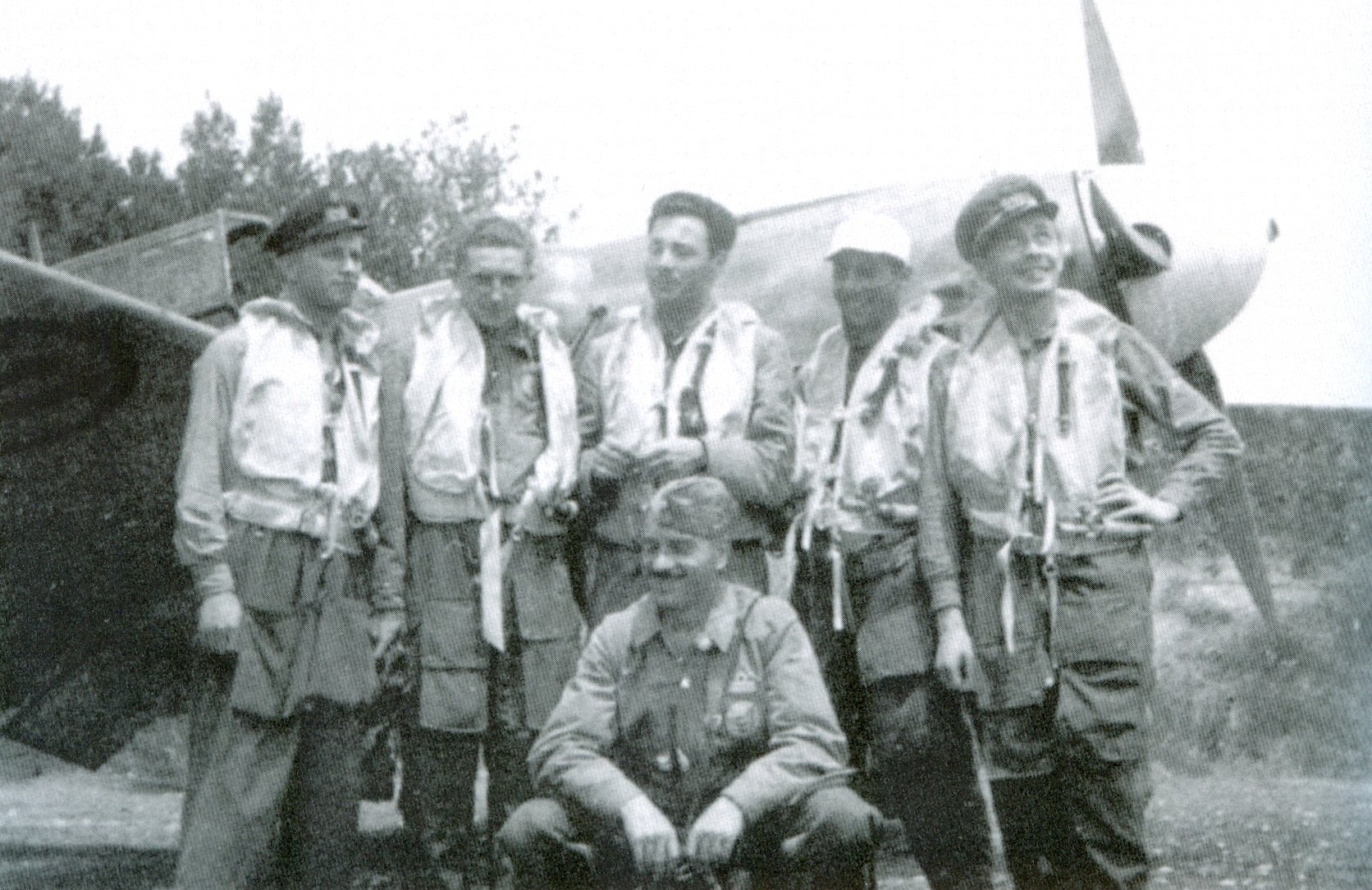
Italian Ace magg. Antonio Vizzotto (the last CO of Gruppo Gigi Tre Osei, from October 1941 to September 1943)
squats in front of pilots as they pose for the camera in front of a Bf.109 G-6 of 150o Gruppo at Sciacca airfield in the
spring of 1943. Among the standing pilots are Ten. Giosue Carillo (second from left), Ten. Angelo Zarelli (in the
centre who was killed in action on 12 June 1943) and Ten. Giovanni Mancini (far right). M. Mattiolo, "53o Stormo" Aviation
Elite Units, Osprey Publishing, 2010.
|
|
Aeronautica Nazionale Repubblicana
The appointment of Lieutenant Colonel Ernesto Botto as Supreme Commander of the Aeronautica Nazionale Repubblicana, of which Vizzotto had been an old
friend since the days of the Academy convinced Vizzotto to join. During the month of October he flew a Saiman 202 between Rome, Padua, Aviano,
Florence, Caselle and Milan to take part in the meetings in which the organizational structure of the new military air force was outlined.
Vizzotto was assigned the initial task of setting up the 2o Gruppo caccia divided into three squadrons, then taking command of 1a Squadra Aerea di Milano.
On March 5, 1944, 1a Squadra Aerea became the 1a Zona Aerea Territoriale (Z.A.T.), and on April 1 was appointed Inspector of Fighter with
supervisory duties. When the Germans attempted to take control of the ANR as a Legion under Luftwaffe control he fought hard with
General Wolfram von Richthofen and resigned from his post. In October 1944 he assumed command of the 2a Zona Aerea Territoriale di Padova,
a position that he still held at the time of the surrender which took place on 25 April 1945. On the 30th of the same month he was arrested by
partisans, accused of being a collaborator and imprisoned for 60 days. Subjected to a purge process, he was suspended from service and then removed from
the official role with the loss of his rank. All measures taken were later rescinded and on 1 March 1948 he returned to service in an official role
with the Aeronautica Militare but was still investigated.
Post-War
On 6 April of the same year Vizzotto was discharged from military service and on 22 April he was acquitted of being a collaborationist but sentenced to one
year of suspension from employment. On March 4, 1950 the review court commuted the sentence to 60 days imprisonment. Embittered Vizzotto left his world
forever, that of aviation, becoming, after the initial difficulties, a representative of the chemical industries. Unfortunately he never
accepted the expulsion from the air force which he considered his life and on 5 September 1956 he took his own life, leaving behind his wife
and three daughters Anna, Paola and Clara.
Maggiore Antonio Vizzotto is credited in some sources with up to five individual victories.
|