|
Academy 1/32 Nieuport 17 Italian Ace Francesco Baracca by Davide Splendore 
|
|
|
|

Click the STORMO! Eagle to return to the Gallery |
|
The 1916 Nieuport 17, probably Gustave Delage's most famous plane, was developed from the 1915 Nieuport 11 'Bébé'. Larger, stronger, and better armed, the Nieuport 17 was one of the finest combat planes of its time. It was one of the best Allied fighters until the appearance of the Spad S.VII. Delage designed the 17 keeping fairly close to the general formula of the Bébé, but eliminated the older plane's defects and improved on its performance. The new plane's fuselage was larger and had better lines. The small lower wing of the Bébé had been found wanting in strength during combat manoeuvres, and had shown an unfortunate tendency to break up in flight. Delage strengthened the structure a great deal to keep the lower wing from twisting. The Nieuport 17 was also more heavily armed than its predecessor. Initially a Lewis machine-gun was mounted on the upper wing, but this was later added to or replaced by a synchronized Vickers machine-gun. There were variations in combat units, some pilots kept the Lewis on the wing, and others mounted twin synchonized machine-guns, although this limited the plane's performance. The Nieuport 17 reached the front in March 1916, and gradually replaced older planes in French units. The first squadron to fly the new fighter operationally was N.57, on May 2. Five other units followed, including the famous 3rd Squadron of 'Les Cigognes'. The plane was also adopted by the Italian air forces. By the spring of 1917 five squadrons of the L'Aviazione Italiana operated the Ni.17. Other Nieuport 17s served with the British, Dutch, Belgian, and Russian air forces. In Italy 150 were built under licence by Macchi, and the first Italian-built Ni.17s were delivered in October 1916. This fighter was so popular with the Allies that in August 1917, 317 of them were still in front-line service. The Nieuport 17 soon became the favourite plane of the leading aces of the time, from the British Ball and Canadian Billy Bishop to the famous French Aces Nungesser, Guynemer, Fonck and Navarre. The plane was also flown by top scoring Italian Ace Francesco Baracca. This fighter proved its worth during the battles of the Somme and the Isonzo, and stood up well against the Fokker E monoplanes, Halberstadt D IIs and even Albatros D Is. The Nieuport 17 proved such a threat that the Germans decided to build it themselves, copying Nieuport 17s that had been forced down behind the lines and captured. The German version of the 17 was manufactured by Siemens-Schuckert but never went into action, because more powerful models of the Albatros began reaching their units. H. A. Jones, the British official Historian of the First World War in the air says the following of the Nieuport 17:. 'While our pushers with skill and determination were subduing the Fokkers the French produced a very effective fighting scout. This was the small single-seater Nieuport Scout (110 horse-power Le Rhône engine) armed with a Lewis gun fired over the top of the plane by means of a Bowden cable. Its performance was superior to that of any contemporary fighting aeroplane. It could reach 10,000ft. in 10 and a half minutes and was 10 miles an hour faster than the best aeroplane of the R.F.C.' References [1] Angelucci E. and P. Matricardi, "World Aircraft, Origins – World War I", Sampson Low Guides, 1977
|
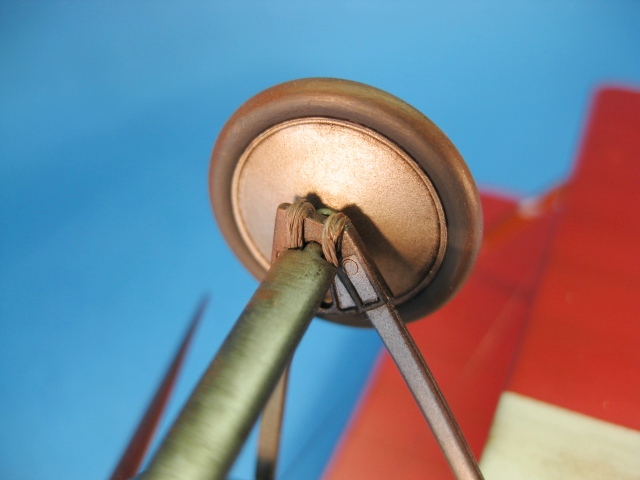
I began this kit direcly from the box, but immediately, the first detail I found were unrealistic pair of wheels, so I decided to strachbuild new with the help of a friend of mine. We replicated the pair of wheels in aluminium using a lathe machine.
To give more realistic look inside the “cockpit” I also decided to scratch build the entire cabine struts based on the original scaled drawings of the airplane.


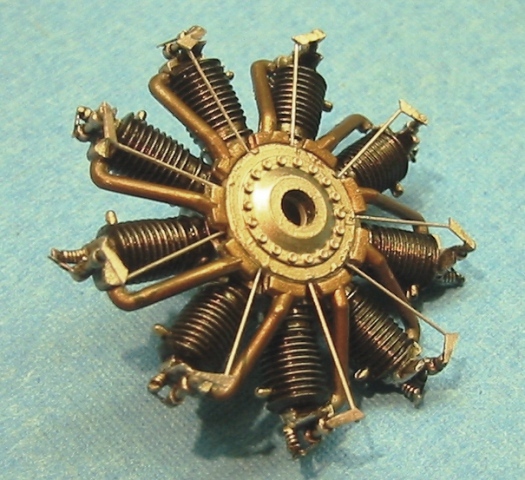
Also the engine was touched-up to give a more realistic look, I scratch built the fuel distribution system above each of the cylinder-heads.


Regarding the wings and tail system, I just added some small details. At this point I glued together fuselage and go on to assembly wings and tail stabilizer. When the airplane was ready, I applied a primer coat (Mr. Surfacer 1000 Gunze)
Mr.Surfacer 1000 Spray - MAB505
. 


I like to give different effects to the “fabric” covered areas as well as those parts in “metal and wood”. So I applied a coat of Alclad “White Aluminium”
White Aluminum 1 Fl. Oz. ALC106
on the “fabric” covered areas. For the remaining parts, first a glossy black enamel base was applied and then painted over in
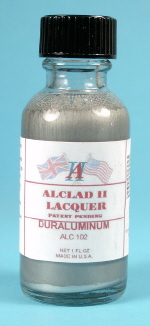
 Alclad “Duralluminium”
Duraluminium Finish 1 Fl. Oz. - ALC102
varnish. 


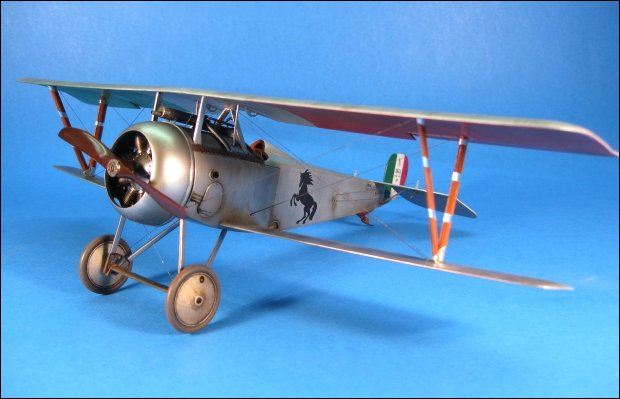
The wings undersurfaces and the rudder took the typical Italian tri-colors, as seen in many original photos of the Nieuport 17 in Italian service. The decals on the rudder were self-constructed. 


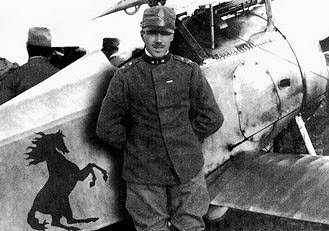
The famous prancing horse of Italian Ace Francesco Baracca was applied using a self-constructed mask as shown below. 

After the first paint step was complete, I began the weathering phase by applying a very light shade of Tamiya “smoke” and brown heavily diluted. In the second step I washed the silver surfaces with artist oils brushed gently in the air flow direction. In the last step I applied artist oils in some defined areas to simulate the intensity of dirt and oil accumulation. At the end of whole process I applied a very light coat of transparent matt varnish (Xtracolor matt) to give the correct satin effect of the surfaces. Finally some artist chalks were applied to the surfaces to simulate powder and dirt on the undersurfaces. 


Regarding wood simulation on the propeller and wing struts, once again I used artist oils. The wing tie rods were made from fishing nylon wire about 0.12mm, attached using superglue. 
Here are the photos of the completed model. Cheers! 


|
Aircraft: Nieuport 17 Manufacturer: Société Anonyme des Etablissements Nieuport Type: Fighter Year: 1916 Engine: Le Rhône 9J 9-cyclinder air-cooled rotary, 110hp Wingspan: 26 ft 10 in (8.17 m) Length: 18 ft 11 in (5.77 m) Height: 8 ft (2.44 m) Weight: 1,246 lbs (565 kg) Maximum Speed: 110 mph (177 km/h) at 6,560 ft (2,000 m) Ceiling: 17,390 ft (5,300 m) Range: 2 hrs Armament: 1 machine gun Crew: 1 |
|
|
|
|
|

|
|
|


|


|
|
|
|
March, 2009 STORMO! © 2009 |