|
Trumpeter 1/48 Savoia-Marchetti S.M. 79 II Sparviero (Sparrowhawk) - Aerosiluranti by Richard Davenport |
|

Click the STORMO! Eagle to return to the Gallery |
|
As the British Spitfire and the American Mustang characterized an era in the history of aviation in their countries, so too did the 'Sparviero' (Sparrowhawk) for Italy. It was certainly the best known Italian aeroplane of the Second World War, and saw duty on all fronts. The aircraft was designed as a bomber, but it became famous as a torpedo-carrier, and was an outstanding airplane. Between October 1936 and June 1943, a total of 1,217 aeroplanes came off the assembly line. It was designed by Alessandro Marchetti, and was developed from the earlier SM.81. Like its predecessor, the SM.79 was a low-wing. monoplane, with a wood and metal structure and a composite covering, but the new three-engine aeroplane incorporated many improvements, such as more powerful engines, which improved performance. It had finer aerodynamic lines, and the retractable under-carriage was designed to raise up into the engine nacelle. The prototype had been designed as a civil transport aeroplane with eight seats. The first flight took place in October 1934, when the aeroplane took off from the Cameri Airport in the province of Novara. It was a brilliant debut. Its general performance was outstanding. The aeroplane flew over 220 mph (354 km/h) at sea level and more than 250 mph (402 km/h) at higher altitudes. The aeroplane improved in performance the following year, when 750 hp Alfa Romeo engines were installed in place of the original 610 hp Piaggio P.IX. In the month of September six world speed records were broken, over distances of 625 and 1,250 miles (1,000 and 2,000 km) with loads of 1,100, 2,200, and 4,400 pounds (498, 997 and 1,995 kg). The military authorities were so impressed with this achievement that they ordered a second prototype in a bomber model. This version did not differ structurally from the civil version, and the only changes were alterations to accommodate bombs and armament in the belly, and the raising of the cockpit. The airplane was used in the Spanish Civil War from February 1937, but it also continued to be used as a civil transport and racing aeroplane. A special model with 1,000 hp Piaggio P.XI engines continued to establish speed records. On December 4, 1938, it flew at an average of about 300 mph (482 km/h) over a distance of 621 miles (1,000 km) with a 2 ton (2.02 tonnes) load. One of the aircraft's finest achievements took place on August 20-21, 1937, when five SM.79C racers took the first five places in the Istres-Damascus-Paris race. A distance of almost 4,000 miles (6,437 km) was covered at an average speed of more than 220 mph (354 km). A top speed was established on the Istres-Damascus leg of the flight, when one of the aeroplanes reached 265 mph (426 km/h). In January 1938 three other SM.79s, trans-atlantic models flew from Guidonia, Italy, to Rio de Janeiro, via Dakar - a distance of more than 6,000 miles (9,656 km) at an average speed of more than 250 mph (402 km/h). At the same time a commercial export model was developed, the SM.79B. This was a twin-engine aeroplane with a modified forward section, powered by a pair of 1,030 hp Fiat A.80 RC 41s, or by two 1,000 hp Gnome-Rhone K.14s. A third engine variant was powered by two 1,220 hp Junkers Jumo 211 D in-line engines. A total of 113 of this variant model were produced, 16 of them in Romania on licence. The aeroplane was sold to Iraq, Yugoslavia, Brazil, and Romania. A final version, the SM.79-III, appeared in 1943. When Italy entered the war, there were 594 SM.79s in service. The plane started out as a bomber, but soon was assigned to torpedo carrying, and was outstanding in this role. It continued in this sort of operation after 1943 in the air force of the Aeronautica Nazionale Reppublicana. In the south, the Allies reassigned the aircraft to transport duty. The SM.79s that survived the war were used for some years as transport aeroplanes and target tugs. The last aircraft were retired from service in 1952. |

|

|
|
|
|
|
|

|
|
|
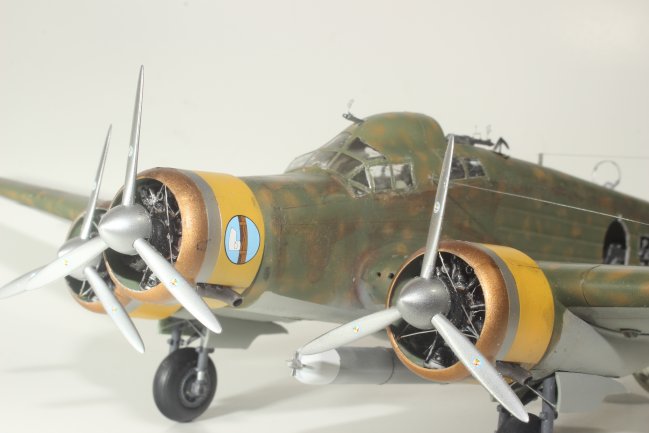
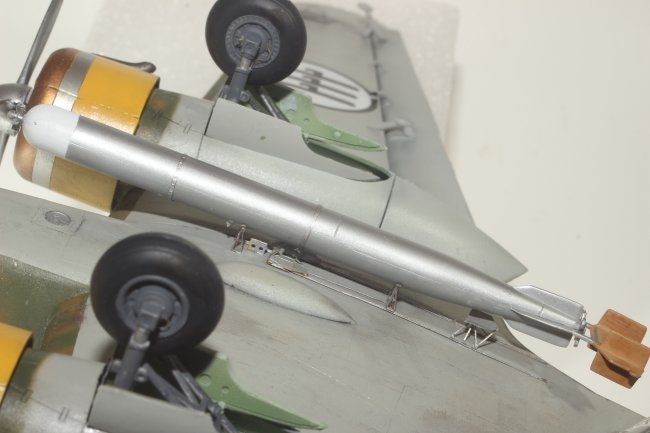
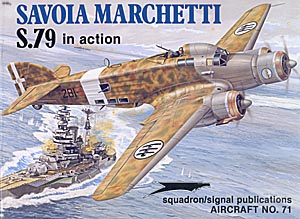
The SIAI-Marchetti S.M.79 "Sparviero" (Sparrowhawk) was originally designed as a fast, eight passenger transport. With its trimotor configuration and rotary engines, it proved to be very fast and won several international air races. In the mid-1930s The Regia Aeronautica recognized the S.M.79 as its first line medium bomber. The aircraft proved its capabilities during the Spanish Civil War for the Nationalist forces of Generalissimo Franco. With the outbreak of WWII, the S.M.79 was also adapted to be a torpedo bomber and first saw action in August, 1940. Stationed at different times throughout the Mediterranean, they attacked various convoys headed for North Africa, the Levant, and especially Malta. This is the Trumpeter 1/48th Savoia-Marchetti S.M. 79-II (kit #02817). It represents 278-1 of 278° Squadriglia Autonoma Aerosiluranti, Regia Aeronautica, Gerbini, Sicily, flown by Capitano Dante Magagnoli on 27 September 1941 in sinking transport Imperial Star during Operation Halberd. Other reviews have identified some of the errors in the kit; nevertheless, it is a straightforward kit that goes together well with few fit problems. I replaced the top bracing of the horizontal stabilizers with nylon thread and wire bracing from the cockpit to wings. The kit was supplemented with Eduard "Big Ed" #BIG4811. Interior color was Vallejo Pastel Green (70.885). Primary exterior colors were LifeColor Grigio Azzurro chiaro 1 (UA 525) and LifeColor Verde scuro Mimetico 39 (UA 530). The splotches were a 50/50 mixture of LifeColor Nocciola 4 (UA 526) and LifeColor Giallo Mimetico 16 (UA 528). Primary resources were Savoia Marchetti S.79 in Action, Squadron/Signal #71 and Savoia-Marchetti S.79 Sparviero Torpedo-Bomber Units, Ospreay Combat Aircraft #106. |

|
Aircraft: SIAI-Marchetti SM.79 Manufacturer: SIAI-Marchetti Type: Bomber Year: 1937 Engine: Three Alfa Romeo A.R. 126 RC 34, 9-cylinder radial, air-cooled, 750 hp each Wingspan: 69 ft 7 in (21.20 m) Length: 53 ft 2 in (16.20 m) Height: 13 ft 5t in (4.10 m) Weight: 23,180 lb (10,500 kg) (Loaded) Maximum Speed: 267 mph (430 km/h) at 13,120 ft (4,000 m) Ceiling: 23,000 ft (7,000 m) Range: 1,180 miles (1,900 km) Armament: 4-5 machine guns; 2,756 lb (1,250 kg) of bombs Crew: 6 |
|






|
|
|
|
|
|





|


|
|
|
|
|
|
November, 2020 STORMO! © 2020 |