|
Savoia-Marchetti S.79 Sparviero Torpedo-Bomber Units by Marco Mattioli Reviewed by Vince Tassone |

|
Authors: Marco Mattioli (Author), Richard Caruana (Illustrator), Mark Postlethwaite (Illustrator) Publisher: Osprey Publishing Ltd., Oxford, UK Publishing Format: Paperback Publication Year: 2014 ISBN-10: 1782008071 ISBN-13: 978-1782008071 Description: 96 pages, 84 b/w photos, 42 color profiles/unit badges Language: English Price: CDN $29.99 (STORMO! Osprey Publications) Recommendation: Recommended 
 |
|
This book covers the Savioa-Marchetti S.79 Sparviero (Sparrowhawk) Torpedo-Bomber units of WWII, from their inception July 25, 1940 to
April 26/27 1945. The book is part of the Osprey series Combat Aircraft #106. The author is a journalist and an historian and a frequent
contributor to history and defence magazines as well as the author of a number of books on Italian aviation. |
|
The book is well written and researched. This is one of those books you can’t put down. Covers the unit histories, inception and crews on a day to day operational basis. The book takes you into the “heat of the battle”. There are some areas of the book that have been edited by Osprey but otherwise the text seems largely unaltered, however some of the translations seem to have been lost (I believe the original text was written in Italian) for example: p.64 – 1st paragraph – “That same day nine S.79s from 105o and 108o Gruppi and 280a Squadriglia (130o Gruppo) flew anti-shipping sweeps off the Algerian coast but achieved nothing.” should read as:“That same day nine S.79s from 105o and 108o Gruppi and 280a Squadriglia (130o Gruppo) flew anti-shipping sweeps off the Algerian coast but failed to make contact with enemy shipping.”
On the same page, the heading “December Slaughter” could have been translated to “December Losses” since 4 aircraft were shot down in
this one engagement. In comparison to earlier loses of one or two (or none at all) per mission, four aircraft lost was considerable but it
certainly was not a slaughter and these loses were paid for by the loss of one confirmed and one probable Spitfire shot down by return fire.
Attack on Gibraltar Harbor June 5, 1944 – 10 attacking Sparvieri - defenses taken completely by surprise (second time!)) with four freighters
claimed hit. English report no hits, anti-torpedo nets detonated torpedoes? Mattioli provides an assessment of the effectiveness of Italian Torpedo-bombers and is summed up in the following:
"From 1940 to 1944 the Regia Aeronautica and ANR torpedo-bombers struck horne 40 times (two torpedoes failed to explode), sinking 21 ships
and damaging 17 others. These comprised nine warships (including three auxiliary units) and 12 freighters. In addition, 11 warships and six
merchantmen were damaged. Comparing these results with those achieved by German torpedo-bombers, the Italians scored more warship successes
(nine sunk and 11 damaged) than the Germans (three sunk and four damaged). As regards heavy-tonnage warships, the Italians damaged one
battleship (using S.84s), one carrier and six cruisers, while the Germans could boast only the cruiser HMS Arethusa damaged. However, the
Germans sank more merchant ships - a total of 31."
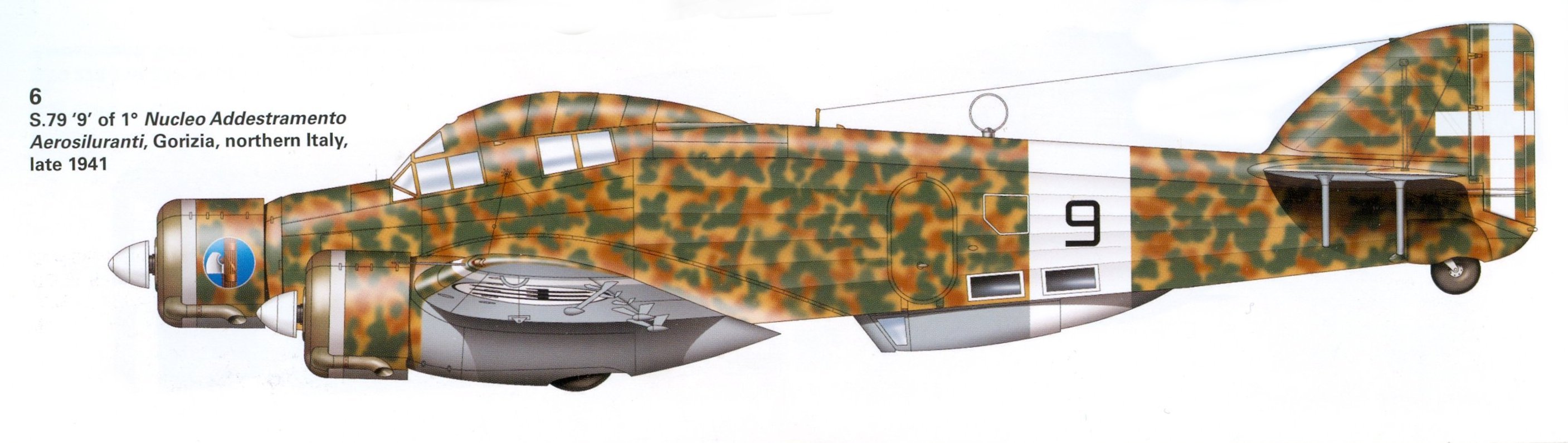
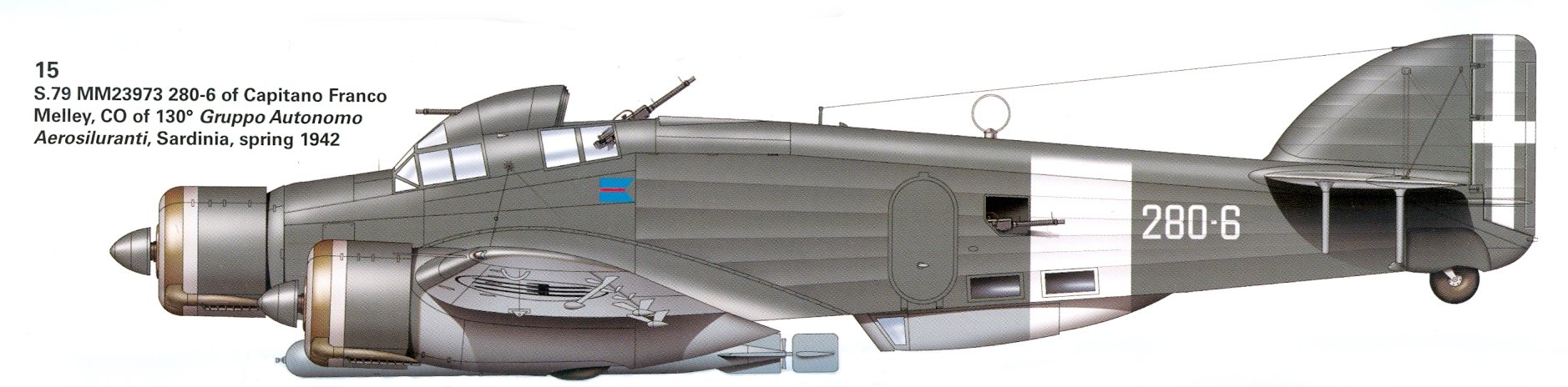
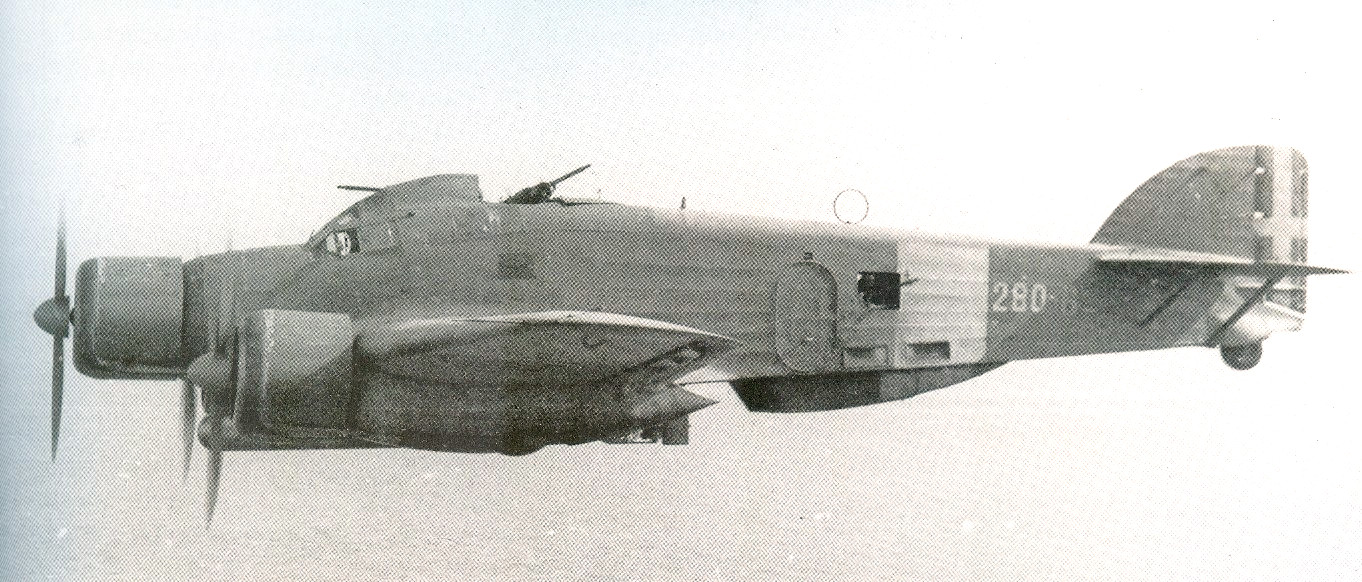
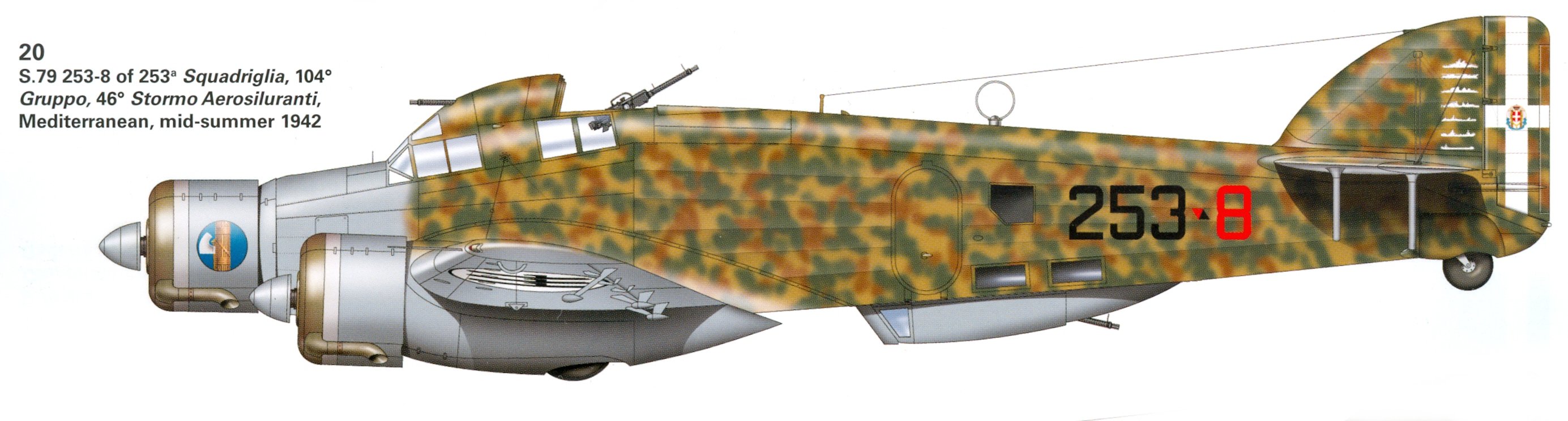
There are 84 b/w photos, many never before seen, 30 color plates (profiles) with descriptions and 12 unit badges also with brief descriptions in the back of the book. |
|
Appendices:
Colour Plate 10 - Verde Oliva Scuro 2 upper surfaces with GAC1 lower surfaces. Colour Plate 11 - plane constructed before Tavola X colors – undersides Grigio Mimetico. Colour Plate 14 - undersides Grigio Mimetico. Colour Plate 15 – Rudder in VOS2. Top surface color non-standard light blue/gray.
Colour Plate 20 – see link for discussion of this plane 253-8, camo E8, VOS2 + GAC1 upper surfaces: STORMO! Forum Discussion
“Serie” were equivalent to production batches, there were 58 Serie Prodcuzione ranging from 4-82 aircraft per Serie with production emanating form SIAI, Macchi, OMI, AUSA. There were four sub-variants of the S.79 III as follows:
S.79 GA/bis: This was the most important evolution of the machine, initially designated S 79 G.A. (for long range), designed and built late in 1942.
Developed in connection with "Operazione Scaglia" (an attack by S 79 torpedo-bombers on the Gibraltar naval base) this conversion was developed from
suggetions of maggiore Buscaglia, wherein great importance was given to a large increase in range. The OMI-Reggiane and AUSA factories received the
task of introducing the appropriate modifications to get the first examples of S 79 GA. The modifications included the adoption of the Alfa 128 RC 18
engines fitted with special SIAl airscrews, the ventral gondola was removed, a 720 l fuel tank was installed in the mid-fuselage section, a German
"Patin" compass was adopted, a torpedo-dropping device was added for the co-pilot, and minor improvements to the armament. Owing to the unfavourable
course of the war for Italy, which also affected aircraft production, by May 1943 only half the S 79 GAs ordered had been produced and delivered to
operational units, while other existing S.79s were modified at other factories and SRAM (the aircraft and engine repair service). Consequently, no
less than three distinct versions appeared to be in service: S 79 bis/N (basic version), S 79 bis/P.M. (partially modified) and S 79 bis/T.M.
(entirely modified). Pilot reports of the new S.79bis were highly favorable, referring to it as different machine [1]. Colour Plate 28-30 – note the name change of the Aeronautica Repubblicana to Aeronautica Nazionale Repubblicana in 29 June 1944. The Colour Plates (profiles) and the corresponding descriptions appear to have been worked on separately by the illustrators while the history/text was handled by the author. Colour Plates 1-9, 11, 14 see CMPR Color Guide to determine hues for verde, marrone and giallo mimetico. |
|
|
|
Unit badges: |
|
|
This is an easy book to read, it’s fast paced with day-to-day operations discussed in some detail and pilot accounts are provided. This book has quiet
allot of detail and because of this it’s thrilling to read and draws you into the action. One thing that should be mentioned is that the
book seems to have been prepared in two parts: the Profiles (Colour Plates and Unit Badges) were worked on separately (independently) by the illustrators
(perhaps with some input from the author) while the text was worked on by the author. I didn’t give the book five stars because of some inaccuracies
in the profiles and some translations (the original text was likely written in Italian and then translated into English). The Appendices seemed to be
missing hits and claims, for example during Operation Pedestal and the Husky landings – these claims might have been augmented into a third
Appendix (D) with Unconfirmed Kills or perhaps some more work is needed by the author to confirm these claims via post-war secondary sources. Other
than that we’re really scrapping the barrel for deficiencies in this book, it really is a great read and a must for RA/ANR fans. This book is
undoubtedly the best on the subject in English and the author did a first rate job. Recommended. |
|
|
|
|
|

|
|
|



|


|
|
|
|
July, 2023 STORMO! © 2023 |