According to Methuen Handbook, Garnet Red is 11E8, similar to FS 10076. Slate Grey is 3F2. In British Standard Colour, Slate is BS 634, close to FS 34096, and there is also a Light Slate Grey BS 639 close to 34159.
I own a copy of original Vitochart chips. You’re right about Verde Azzurro Scuro 9, it is similar to Verde Mimetico 2, but a little more bluish to it and to FS 34092. It is halfway between Methuen 25F4 and 26F4. I think it’s too much blue to represent a race green. Not to mention, "garnet red" and slate green" are merely descriptive terms. Let's see the official documents. Indeed, I’ve found something interesting in Borgiotti & Gori’s “Il Savoia Marchetti S.M.79 Sparviero” (USSMA, Rome, 1984). In late Summer 1936, when Italy decided to participate to the “Blue Ribbon” New York-Paris race (later replaced by Istres-Damascus-Paris), Italian team leader Col. Attilio Biseo asked, among the S.79 modifications, to paint the aircraft in Rosso Fuoco (fire red) (p. 14). The reason of it is that red was the colour previously assigned to Italy by International Car Race Committee (see Alfa Romeo and, later, Ferrari racing cars). If you want to have an idea of Italian Rosso Corsa (race red), take a look here:
http://www.ams.vr.it/dat/Imm_Aero.htm. The first ’79, MM 355, Bu.No. 51, modified as S.79C, had the nose and a “flame” along the fuselage temporarily painted in blue, in honour to SIAI firm colour, and this justifies the artwork in Profile 89. After official RA disposition, however, it was later turned to green to recall Italian flag. (caption at p. 11 – the photo is the same to that at bottom left in p. 3 of Profile 89). The aircraft were finished with the following paints (p. 16 and 26):
Arson SISI Giomar Avio 3217 Rosso
Arson SISI Giomar Avio 3216 Verde
Arson SISI Giomar Avio Verde Chiaro (light green, for the mice)
DUCO Aeronautica Nero Fuoco (fire black -!-)
DUCO Aeronautica Bianco Zinco (zinc white)
DUCO Aeronautica (?) Bianco Titanio (titanium white)
All colours were gloss-varnished or polished.
The Ratier propellers were overpainted with a light color (p. 26). Although the latter was not specified, note that usually SIAI painted the front face of propellers in a light blue similar to FS 35526, or light grey (at least later in 1940). The same colour was applied to spinners.
The following is a catalogue of Arson SISI aircraft paints in 1937-38, where Rosso 3217 and Verde 3219 are present, and this could lead to think that they were the same colours used for rudder flag and tubing…

…but a painting guide by SIAI, dated 21 February 1940, shows that, at least that year, Rosso and Verde used for flag had other identifications codes.
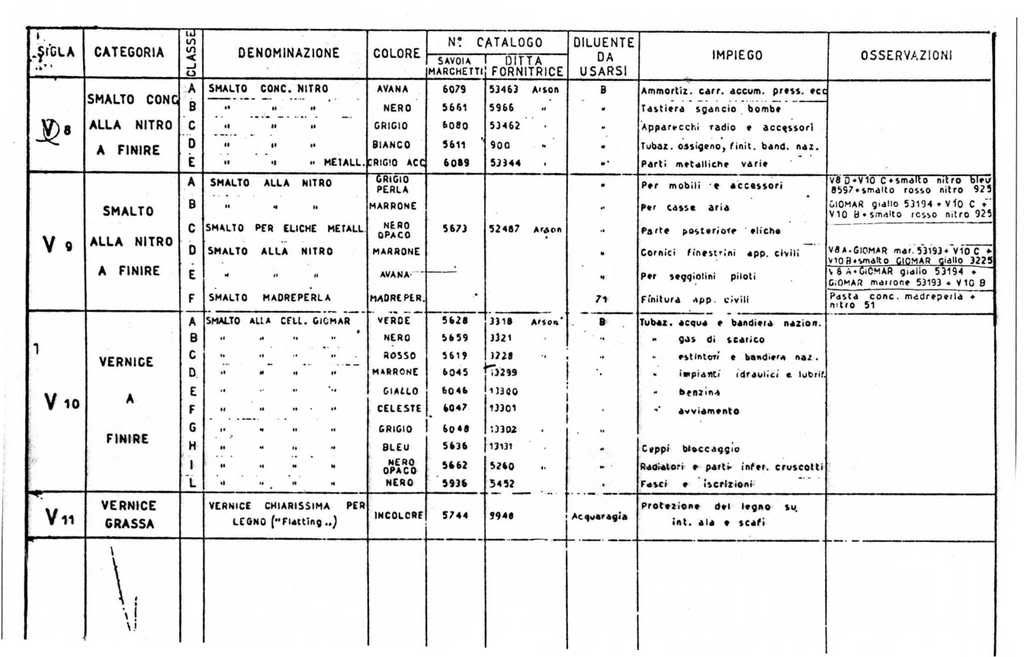
Were they different hues or the same colours recoded? Probably we’ll never know. Although Arson SISI and DUCO paint manufacturers are still in activity, old catalogues sadly had been lost.
The edging of the green in the fuselage was not natural metal, as the fuselage behind the cockpit was covered by fabric, and images don’t show variation of shade between the two parts. Aluminium paint is not listed above, titanium white is a ‘pure’ white (at least on the walls of my home), so the borders were painted in zinc white. I cannot tell you how this colour was, but it should have been a sort of greyish or metalized white (paint + zinc powder?). Instead, it is sure that engine cowlings and wing leading edges and roots were polished natural metal.
I’d better prefer a more rich green for the mice, in the area of FS 34230-34540 or so. In my opinion, the green colour of them was very distinctive, and could have not been dilute into a greenish grey.
Now, let’s examine the pennant and try to guess the colours.

The pennant was double-outlined white (outer, sure) and blue (inner, probable). The S.79 logo was a dark colour outlined yellow (probable) and had as background the Verde 3216 (sure). The anchor was yellow (sure) in a blue circle (sure). The writing “SAVOIA MARCHETTI” was yellow too (probable). The pennant cross was a dark colour, possibly the same of the logo, and its background was pale blue (sure). As the logo and cross were not green, they should have been black, red and/or dark blue. Which colour?
A photo took with an orange/red filter comes in help.

Here the red appears much lighter than green, but also the logo and the cross do, suggesting they were red too!
Any doubt?
Stefano