|
Hasegawa 1/48 Macchi C.205V Serie VI Veltro (Greyhound) - Herringbone Scheme by Jean Barby 
|

|
|
|

Click the STORMO! Eagle to return to the Gallery |
|
When a more powerful version of the German Daimler Benz became availlable, the last Italian fighters of the war were built. These aircraft were on a par with the best American, British, and German aircraft. The Macchi MC.205 was the first Italian airplane to be powered by the new engine, and it was also the first 'Series 5' aeroplane to see substantial service before the 1943 armistice. The prototype took to the air on April 19, 1942. It was derived from the MC.202. The only apparent difference between the MC.205 and its preedecessor was the engine housing. The MC.205 also had two cyclindrical oil coolers on each side, while the earlier airplane had a single belly radiator. Because of the greater power of the Daimler Benz DB 605 (1,475 hp), the MC.205 was a far better plane than the MC.202. The prototype reached a speed of 407 mph (655 km/h), and it could gain 20,000 ft (6,096 m) in 4 minutes and 52 seconds. The MC.205 was the first Italian fighter to carry 20 mm cannons on the wings, indispensable for bomber interception. This was the first Italian airplane to be as heavily armed as those of other air forces, and with the bigger and more powerful engine, the MC.205 was an extremely manoeuvrable aeroplane, especially at medium and low altitudes. Large-scale production was ordered at once, but production was slowed down by scarcity of strategic materials and engines. Between October 1942 and September 1943 about 200 aircraft were built. Macchi continued to build the airplane even after the 1943 armistice and another 112 airplanes were built before the assembly line was put out of commission by Allied bombing raids. All these aircraft were delivered to Mussolini's ANR. The aircraft became operational in 1943 and was used chiefly in the Mediterranean and in Sicily at the time of the Allied invasion. The period of greatest activity, however, was after the 1943 armistice. At this time thirty-four aircraft were used by the Allies, especially on the Yugoslavian front, while in the north there were 29 Macchi MC.205s in addition to the 112 new ones that were already built. All these aircraft remained in active service until the summer of 1944. A few MC.205s were kept in service after the war. They were assigned to the 5th Fighter Group until 1947 and were then reassigned to flying schools, where they remained operational until as late as 1951.[1]
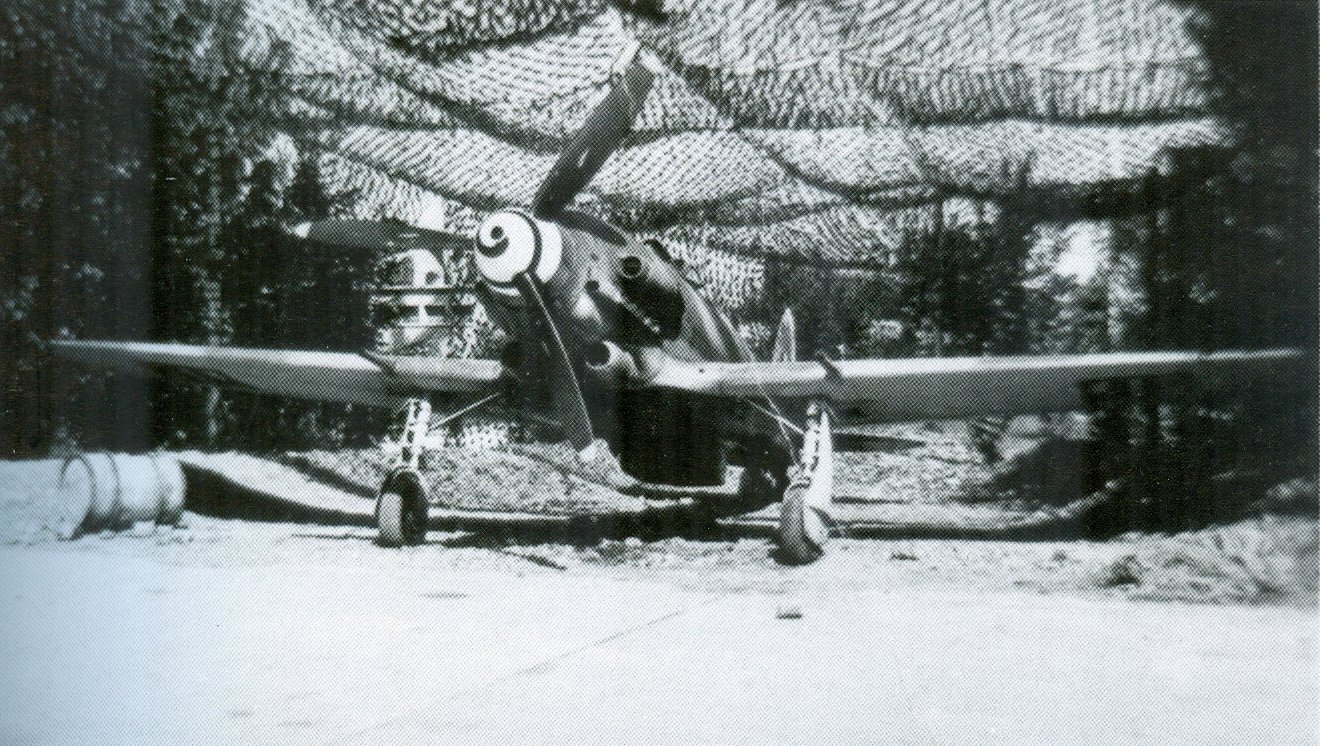
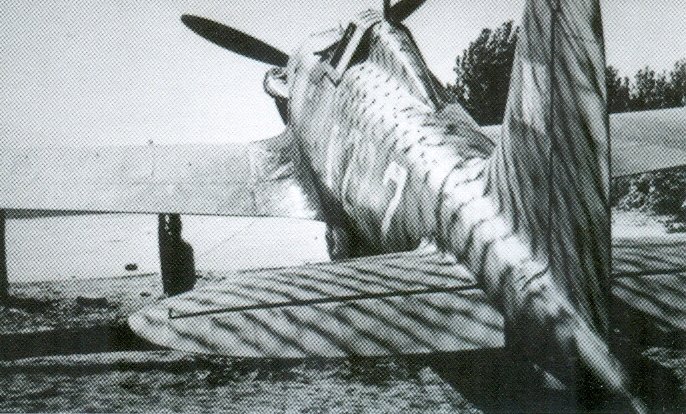
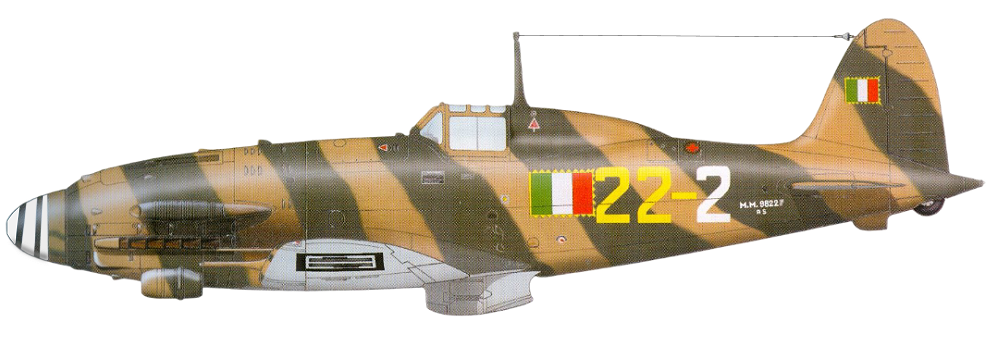
Herringbone Pattern The last C.205 belonging to Serie III (MM.92302), produced at the end of February 1944 and delivered to 1o Gruppo Caccia (later coded as '23-1 '), had originally been completed by the factory in the old tropical camouflage and was later repainted in the field 74/75/76. After the end of Serie III, Macchi was authorised by the Germans to continue production building 15 C.205s of Serie VI starting with MM.98218. The first of these was tested by Macchi test pilot, Guido Carestiato, on 10 March and made two more flights on 11 and 15 March, before being delivered to Sq. 'Montefusco', on which unit's strength it appears on 15 April. While the heavy damage sustained in the bombing of the Macchi factory on 30 April 1944 put a stop to further production, eight more C.205s (MM.98219-98226) had been completed at Lonate Pozzolo between 23 March and 29 April. It is uncertain whether operations there ceased entirely owing to increasing Allied air activity, but the six remaining C.205s were completed. No photographs of MM.98218 have been discovered, but three photographs have been identified as showing the second aircraft in Serie VI, MM.98219, tested by Carestiato on 23 March 1944. Macchi, like FIAT, had at some juncture received an order to change the finish of its fighters' uppersurfaces from the Nocciola Chiaro 4 smoke rings in VOS2 to the herringbone scheme of the same two colours, but unlike FIAT's practice, demarcation of the bands was not wavy but in straight, soft lines. The spinner Nocciola Chiaro 4 and all the national markings were in the standard factory position with the fuselage flag still placed just behind the cockpit, notwithstanding the shift of position towards the tail that 1o Gruppo had been applying since March, along with the introduction of the German greys. Two photographs from different sources were discovered showing Macchi C.202s operating with the Luftwaffe, one with JG 108 as an advanced training aircraft and a second, operating with a similar unit, which had crash-landed in Sweden. Both aircraft were camouflaged in a manner identical to the C.205s with the herringbone scheme. Both of these C.202s were of old construction and had been refurbished by Breda, the only factory engaged in this work in 1944, which is why their camouflage does not appear to be weathered. The only logical and possible explanation why Breda painted the C.202s in such a peculiar way, and especially why they appeared identical to the C.205s photographed at Reggio Emilia and Vicenza, is that between March and April 1944 FlAT, Macchi and Breda had each received an order to replace the camouflage on the newly-produced aircraft with the light brown/sand and green/dark green herringbone scheme. This was applied in alternate bands on the uppersurfaces, with the undersurfaces in GAC1. These observations are confirmed by a photograph taken at Lonate Pozzolo which shows Ten. Bruno Citelli standing by the nose of a C.205 painted with the new striped camouflage. The cowling of this plane is not yet painted yellow, which indicates that the machine had yet to reach an operational unit where the task of painting the cowling would have been carried out. It is believed that Macchi was either the first to apply such camouflage, starting with MM. 98218 or the next machine in the batch - the basis for this is that MM.98219 is visible in at least two photographs taken at Reggio Emilia during May 1944 (see below).[2]
[1] Angelucci E. and P. Matricardi, "World Aircraft, World War II – Part I", Sampson Low Guides, 1978 [2] D'Amico, Ferdinando and Gabriele, Valentini, "Camouflage and Markings of the Aeronautica Nazionale Repubblicana 1943-1945:
A Photographic Analysis Through Speculation and Research", Classic Publications (Ian Allan Publishing), Surrey, 2005
Camouflage and Markings of the Aeronautica Nazionale Repubblicana 1943-1945

|
The first step in construction was to deal with the wings where you must suppress the existing panels and re-scribed the new ones to the proper oval shape, that's for the top. On the underside the shell ejection holes must be improved. For that operation I made a greater hole, and I built the structure with thin plasticard. It is a much easier process than drilling and filing. Using the Maurizio di Terlizzi book I worked my way to the nose of the plane, where, again new access hatches must be scribed, and some must go. 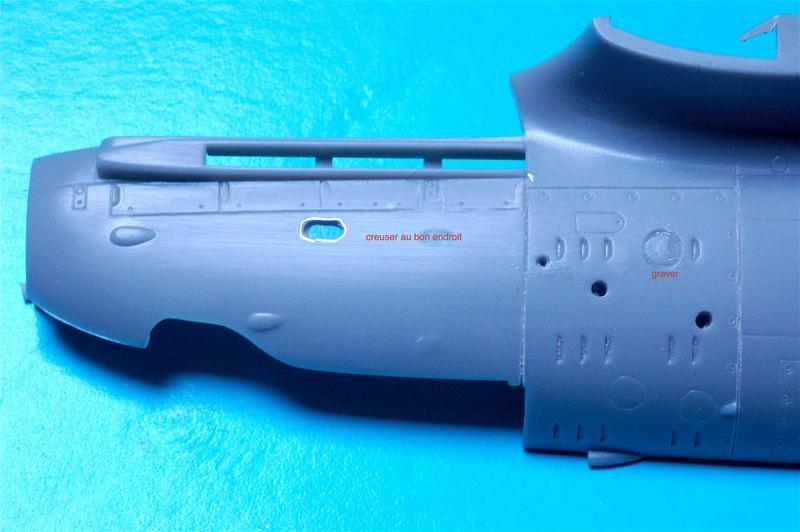


I like my Macchis to look like the real thing. That's why I used a resin engine to simulate the end of the DB605. I also built the fire wall and as many connection hoses as I could using the pictures from the Aerodetail book. Plasticard is used for the holed plates around the wheel bays, and the undercarriage legs are treated as a separate unit. Resin wheels are from Ultracast.
ULTRACAST Macchi C.202/205 Wheels (radial tires) - 1/48 - UC48176
Of course some dry fitting will help to get the thing right. 


The cockpit was made using the excellent but now OOP FM set; I sincerely hope that it'll be available again somewhere because its an outstanding set. You may judge now the result of the previous work on the wheel bay. Dominant color is the Verde anticorrosione, mine is from an old Aeromaster tin.

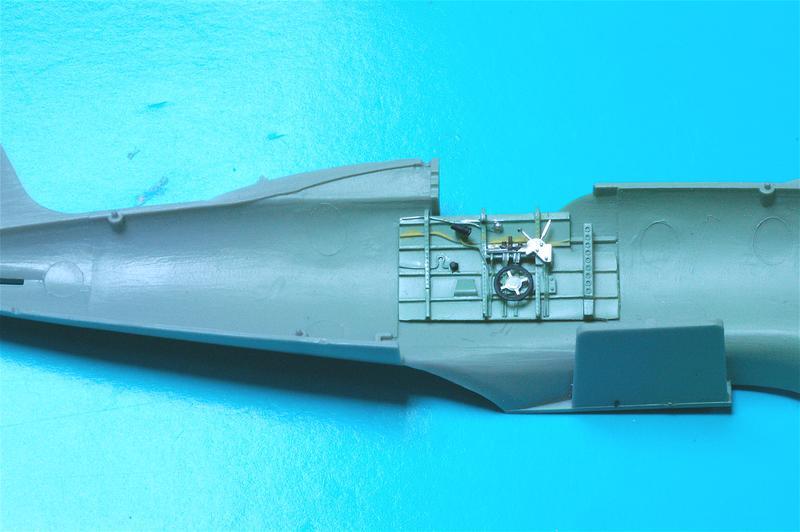


Using the Eduard photoetch set to dress the radiator, enhanced the whole thing. Nevertheless you will have to add two retraction arms to the movable plate as the kit shows only one. The stabilisors are from Sky and a rod was used to assure the proper alignement of both parts. Some more details were added to the undercarriage doors, attachements to the leg. Plasticard and punch and die were put to good use there. Be aware that the contour of the door is different on the 205. 


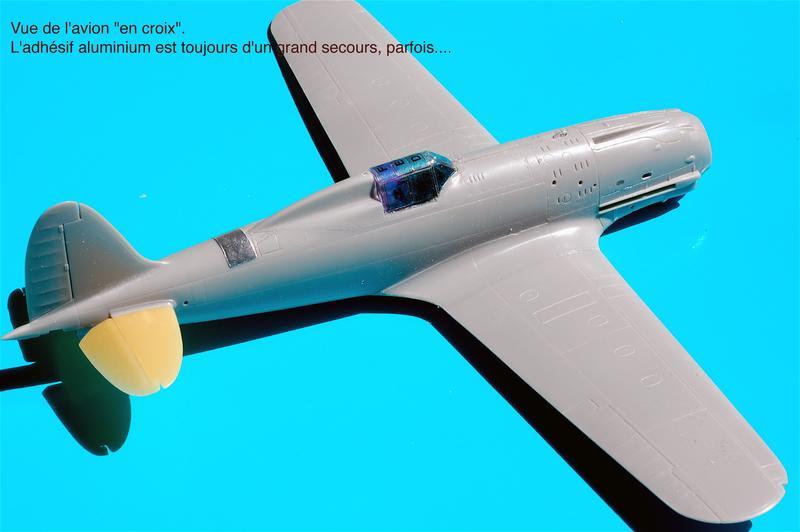
The painting process was very classic: Griggio Azzuro Chiaro for the underside. Masking of the underside leaving the leading edge free for Nocchiola Chiaro, and then the "Herringbone" stripes in Verde Oliva Scuro. Decals are from Italian kit and I did the same mistake on the right side that I did on my Centauro: I put the flag with the red in front! I have rectified this since then. The final touch was the use of Ultracast exhaust, and "Voila" a new "Veltro" in my collection! 


|
Aircraft: Macchi C.205 Serie III Manufacturer: Aeronautica Macchi S.p.A. Type: Fighter Year: 1943 Engine: Damiler Benz DB 605A-1, 12-cylinder V, liquid-cooled 1,475hp Wingspan: 34 ft 8 1/2 in (10.59m) Length: 29 ft 1 in (8.85 m) Height: 10 ft (3.05 m) Weight: 7,120 lb (3,224 kg) (Loaded) Maximum Speed: 403 mph (650 km/h) at 24,300 ft (7,400 m) Ceiling: 37,200 ft (11,350 m) Range: 646 miles (1,040 km) Armament: 2 x 12.7mm (0.5 in) SAFAT machine guns, 2 x 20 mm cannons Crew: 1 |


|
|
|
|
|
|
|
|
|

|
|
|



|


|
|
|
|
October, 2008 STORMO! © 2008 |